
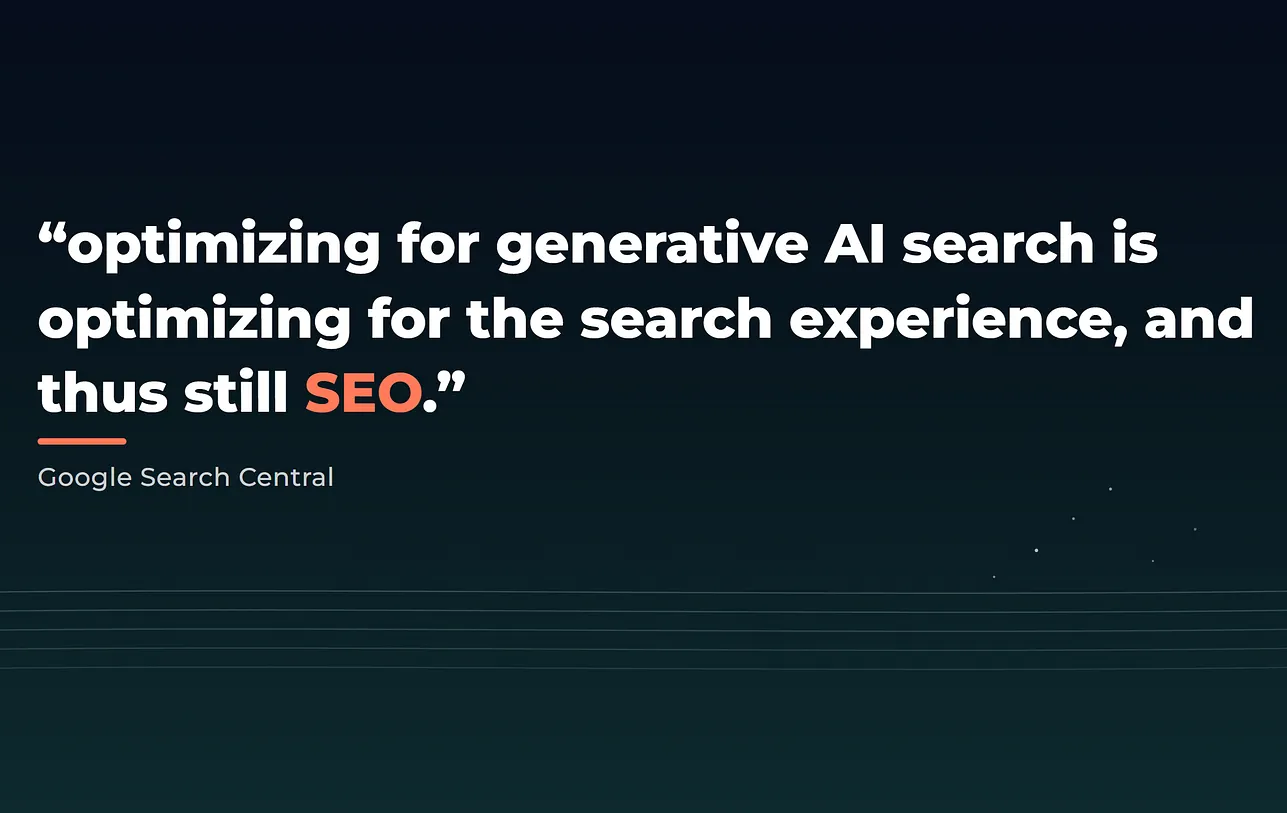
AEO and GEO are Essentially SEO—The Same Rules Apply
My colleague Curtis Hays wrote an extensive examination into the biggest buzzwords to hit marketing since SEO became all the rage: the similarly monikered “AEO” and “GEO.” What his analysis of real-world data and expert-led observation reveals may come as a surprise to many: Though the game has changed, the rules have not.
A few relevant excerpts:
AEO is answer engine optimization. GEO is generative engine optimization. Both mean work aimed at getting your business mentioned in answers from tools like ChatGPT, Perplexity and Gemini.
and:
Marie Haynes published “GEO is a distraction,” with 12 months of Google Analytics data from 100 sites. All the AI chatbots combined sent 0.73% as many sessions as Google organic. Across the 55 sites that tracked conversions, Google organic drove 964 and all the chatbots drove 36, about 3.7 for every 100. The other 45 sites tracked no conversions at all.
and further:
SEO is real work. If I charged for AEO or GEO as its own monthly line, I’d be selling snake oil. Schema markup, FAQs on your website, resource guides, a proper robots.txt and a proper sitemap are SEO work. The three questions near the end ask for the difference in writing.
and finally, and perhaps most importantly:
[S]end the person pitching [AEO or SEO] three questions:
Before we approve this fee, we need three answers in writing:
- What does this buy that our SEO scope doesn’t already cover? Please name the deliverables.
- What result does it have to produce, and how will we measure it?
- When do we review it, what number does it have to hit for us to keep going?
If nobody can answer the first one, leave the fee off the proposal until someone can.
So Now What?
Here’s the upshot: Whether you’re talking AEO, GEO or the proven fundamentals of good SEO work itself, the rules of the game are the same: great content slays many dragons. No matter what the endeavor, any marketing strategy should ask and answer:
- For whom are we doing this?
- What do we want to accomplish?
- How are we defining success?
The answer to all of these should absolutely be examined through the prism of client or customer acquisition. The latest metric to come along—whether you can elevate your AEO referral rate from a paltry 1.7% to something remotely significant—is secondary. What remains primary: how are we optimizing our marketing spend to achieve the real end-goal we have clearly defined in writing?
It just so happens that a well-strategized and well-executed content plan checks all of the primary and secondary boxes at once, by which I mean:
- Answer the questions that your ideal clients are grappling with currently.
- Demonstrate your expertise and track record to solve the problems your audience needs solving.
- Send the proper signals to search engines and answer engines alike that you are a credible source with demonstrable expertise and a track record of sharing that expertise publicly, accessibly and consistently.
- Feed your content engine (social media, email marketing, website, publishing channels, content communities, etc.) with media-rich content that attracts attention, earns trust, and converts interest into opportunity.
Do all of that with one cohesive program, built around a content strategy directly and dogmatically aligned with your customer’s WHY, and you will not only serve the actual humans who pay you for products and services, but the bots and crawlers that get to decide whether your content is relevant and reference-able in search or chats with LLMs.
You don’t need to chase fads or allow an AEO tail to wag your brand-strategy dog. That’s a recipe for attuning to the wrong success metric…and you’ll be doing so at significant cost to your broader marketing strategy and business objectives.

Tom Nixon
Tom Nixon is Chief Content Strategist + Creator with Creative Mill.
An author, musician, and amateur movie maker, Tom has been creating content of all types and formats for more than 30 years.