Category: Storytelling

  • More Tools Than Ever. The Needle Still Isn’t Moving.

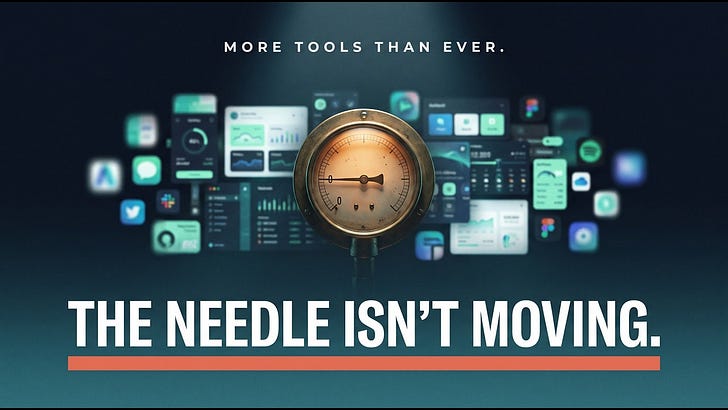
    More Tools Than Ever. The Needle Still Isn’t Moving.

    What happens when an industry’s quality gate disappears—and why the same thing is happening to marketing right now.

    The following is reprinted from our Substackour Substack, Bullhorns and Bullseyes Bullhorns and Bullseyes, written by my co-host Curtis Hays of Collideascope

    Every marketer I talk to right now has more tools than they’ve ever had in their career. Websites you can stand up in an afternoon. Free reach to anyone on earth through social. Now AI sitting on top of all of it, writing the copy, building the images, answering in seconds what used to take a week.

    And the needle is not moving.

    Not because the tools are bad. Not because the team isn’t trying hard enough. It’s because tools amplify whatever’s underneath them, and most of the time what’s underneath isn’t solid enough to amplify.

    Watch Now: Why Are We Stuck?

    I’ve been circling this problem longer than I realized. In 1998 I was working nights at a bank, running mainframe jobs on a Unix box, balancing transactions while the system chewed through its batch. There was a lot of downtime in that job, and I filled it writing. Not marketing. Just sitting with a hard question long enough to actually get somewhere with it, instead of reaching for the first answer. I never finished college. I didn’t know it at the time, but that was the first real practice I had at digging past the obvious answer to the true one.

    Tom Nixon, my co-host on Bullhorns & Bullseyes, has been circling the same instinct from a different direction for thirty years, across two novels and a career in advertising production. Neither of us invented this argument last week. We just finally said it out loud on air: we’re writing a book together. It’s called The Marketing Reformation.

    None of that is the point. The point is the argument underneath it. Every time an industry’s quality gate comes down, volume explodes and the average collapses. Record labels used to force a musician through years of proving they could actually play before anyone heard them. That gate came down, and there’s a line from Toto’s Steve Lukather that Tom’s heard attributed to him more than once: back then you needed real musicianship to make a world-class album, now all you need is a celebrity and a laptop. Advertising had the same gate. Mad Men-era agencies were full of their own sins, but at minimum they made someone do their homework before an idea reached a client. WordPress took the same kind of gate down for building a website. You don’t need a developer anymore, so you don’t get one, and now there are a hundred million websites that say nothing. AI is doing this to marketing right now, faster than any of the previous collapses.

    Tom put words to the distinction we keep circling back to on air: anyone can come up with an idea. The job was never coming up with it. The job is making the idea hold with the customer. Marketing’s default move is skipping straight to the coming-up-with part and calling it strategy.

    I wrote down a line from a Brian Clark newsletter a while back that’s stuck with me since: once you understand your wiring, you don’t choose your movement, you come to recognize it, because you understand which movements already resonate with who you actually are. That’s what this book is for me. Not a new idea. A recognition of one I’ve been circling since a bank mainframe in 1998.

    Tom’s friend Chuck Bean has a line he uses with clients constantly: you’re not arguing with me, you’re arguing with the data. That’s the whole discipline in one sentence. Find the customer’s actual truth first. Then, and only then, turn the amplifier on.

    I was raised Lutheran, and the title isn’t an accident. The Reformation wasn’t Luther inventing a new belief. It was a correction back to what people already, authentically believed, once the gatekeeper standing between them and it got out of the way. That’s what Tom and I think marketing needs right now: a correction back to the truth the whole apparatus was supposed to serve, before anyone turns the amplifier on.

    The prologue is written. The outline is locked. We’ve already got three or four chapters down, passed back and forth between us. We said out loud on air that we’re aiming for this year. Now we can’t renege.

    We’ll be publishing the deeper cuts here as we write. If you want to watch this get built instead of just reading the finished book, this is where that happens.

  • Why Expert-Led Content Wins in a Noisy Market

    Why Expert-Led Content Wins in a Noisy Market

    Authority starts with clarity.

    Attention is easy to chase and hard to keep. For experts, consultants, and professional brands, the real opportunity is not to publish more noise, but to share ideas with enough clarity and consistency that the right people begin to trust you before they ever reach out.

    That is where expert-led content makes a difference. When your insight is shaped into strong written, audio, and video content, your expertise becomes visible, memorable, and useful. Instead of trying to sound bigger than you are, you show people exactly how you think and why your perspective matters.

    Many businesses know they have something valuable to say, but struggle to turn raw knowledge into content people actually want to engage with. Notes stay in notebooks. Voice memos stay unedited. Great conversations never become articles, podcast segments, or short-form videos.

    Clear content bridges that gap. It takes your expertise and gives it shape, so your audience can understand what you do, how you think, and why they should trust you. Good content is not filler for a calendar. It is a business asset that builds credibility over time.

    One idea, many formats

    Strong content marketing does not begin with random posts. It begins with a meaningful idea and a smart way to adapt it across channels. A single expert insight can become:

    • a thought leadership article that explains your point of view
    • a podcast episode that adds personality and depth
    • a short video that makes the idea easy to share
    • website copy that sharpens your positioning
    • social content that keeps the conversation going

    This is how content starts working harder for your business. Instead of reinventing the wheel every week, you create a system that turns expertise into a steady stream of useful, aligned communication.

    What audiences respond to

    People are not only looking for services. They are looking for confidence. They want to know that the person or team behind the brand understands the subject deeply and can communicate it well. The businesses that stand out are often the ones that teach generously, speak clearly, and show up consistently.

    When expertise is communicated with creativity and consistency, content stops being promotion and starts becoming proof.

    How Creative Mill approaches content

    Creative Mill helps subject matter experts turn ideas into authority-building content. That means shaping insight into writing, audio, video, messaging, and thought leadership assets that feel true to the expert behind them. The goal is not generic marketing language. The goal is content with substance, voice, and strategic purpose.

    Whether the starting point is a rough concept, a recorded conversation, or years of experience that have never been documented properly, the process is the same at its core: listen closely, find the strongest ideas, and build content that helps the right audience understand their value.

    A better way to be seen

    If your business depends on trust, your content should do more than fill space. It should reflect your thinking, support your reputation, and make your expertise easier to discover. In a crowded market, the clearest voice often carries the furthest.

    Expert-led content is not about saying everything. It is about saying the right things well, in the formats your audience already uses. That is how ideas become authority, and authority becomes momentum.

  • Make Your Content Engine Purr

    Make Your Content Engine Purr

    A New Model for Content Marketing in 2026 and Beyond

    Two years ago, simply showing up was enough.

    If you published consistently, demonstrated expertise, and shared thoughtful perspectives over time, you separated yourself from most of the market. Content marketing worked because not everyone was doing it well — or doing it at all.

    Today, everyone is showing up.

    And most of them are using AI to do it.

    That doesn’t mean content marketing is dead. It means generic presence is dead. The problem isn’t volume. It’s believe-ability.

    We are no longer just competing with other professionals. We are competing with artificial voices, auto-generated expertise, and an endless stream of frictionless content. Even if your ideas are legitimate and human-generated, your audience may assume they aren’t. And if they believe they can prompt the same answer from ChatGPT in ten seconds, why should they read your blog post?

    That is the real shift.

    The End of Serial Publishing

    For years, the standard prescription looked like this: pick a topic, write a post, publish it, and repeat next week. Over time, that steady drumbeat built authority and brand preference. When someone eventually entered the market for your services, you were top of mind.

    In theory, that still works. In practice, it now produces something far less satisfying: invisibility.

    When every piece of content stands alone, when each post resets the clock, and when nothing builds toward a defined outcome, you are not creating momentum. You are maintaining motion. The difference matters.

    If 2026 demands anything of content marketers, it’s this: stop publishing serially and start building strategically.

    Instead of thinking in weekly posts, think in 90-day arcs. Instead of asking, “What should we write about this week?” ask, “What outcome are we driving toward this quarter?”

    Content without a defined destination is now just noise with grammar.

    The Four “Purrs”

    If your content strategy is going to cut through AI saturation and audience skepticism, it needs four deliberate characteristics. Together, they create what I call The Four “Purrs” — and ultimately, the fifth and most important result. (Spoiler alert: it also rhymes with purr.)

    1. Purposeful

    Content must be aimed. Not vaguely. Not aspirationally. Specifically.

    It’s no longer enough to say, “Over time, this will build trust.” The strategy should define a measurable objective inside a defined window — typically 90 days.

    For example: one clear purpose is to enroll as many members of your addressable market as possible into a live webinar, workshop, or in-person event. That singular objective changes how you create content. Each post becomes runway. Each video becomes reinforcement. Each email becomes part of a sequence.

    You begin to see your audience more clearly as well. There are learners who consume quietly. There are lurkers you cannot measure but know are there. And there are hand-raisers — the persuadable segment who are willing to take the next step.

    Your content must give them something to raise their hand to. Purpose creates direction. Direction creates momentum.

    2. Persistent

    Consistency used to be enough. Now it must be consistency with intention. Persistence is different: it’s consistency with purpose.

    Persistence means narrowing your focus over that 90-day arc. Instead of writing about a dozen disconnected topics, you select one core tension: one problem, one theme, one drumbeat …and you’re going to approach it persistently from multiple angles.

    You explore it through stories, analysis, examples, frameworks, and commentary. You repeat the central idea without repeating yourself. By the time your culminating event arrives, your audience should not wonder what it will cover. They should be expecting it.

    Persistence builds familiarity. Familiarity builds trust. Trust makes persuasion possible.

    3. Persuasive

    Education is valuable, but information alone is no longer scarce. Transformation is.

    Professional services are typically purchased at a moment of inflection — when someone decides they can no longer tolerate the status quo or they finally choose to pursue an aspiration. Effective content moves people closer to that decision.

    This does not require manipulation or aggressive selling. It requires clarity. Your content should demonstrate that the current path has limitations, that an alternative exists, and that you understand the emotional and practical tension your audience is experiencing.

    If your strategy is purposeful and persistent, persuasion becomes a natural byproduct. You are not pitching constantly; you are preparing thoughtfully. Over time, the persuadable segment of your audience begins to consider change.

    4. Personal

    This is where the human advantage becomes unmistakable.

    Written content alone now competes directly with AI. Machines will always win on speed and scale. Humans win on presence.

    Video. Live webinars. Unscripted commentary. Podcasts. Real conversations. When people see you think in real time, when they hear your cadence and observe nuance in your delivery, your expertise becomes authenticated. You signal authorship. You signal authenticity.

    In an era of synthetic content, visible humanity becomes a differentiator.

    Personal content does not replace written content. It validates it.

    The Fifth “Purr” → Permanence

    When content is purposeful, persistent, persuasive, and personal, something powerful happens: it gains permanence.

    Instead of disappearing into the feed after 24 hours, your ideas stay in the market for 90 days. They build anticipation toward a defined moment — a live event, a webinar, a workshop, or a briefing.

    That event then becomes fuel for the next 90 days.

    You record it. You gate the replay. You extract short-form video clips. You generate companion blog posts. You develop follow-up emails. You create derivative assets that extend the lifecycle of a single idea.

    Your strategy compounds rather than resets.

    You are no longer producing isolated posts. You are programming reputation over time.

    The New Discipline

    The truth is, AI did not kill content marketing. It exposed outdated strategy.

    The brands that will win in 2026 and beyond will not be the ones producing the most content. They will be the ones building structured, human, outcome-driven arcs that culminate in meaningful engagement.

    The question is no longer, “What should we publish this week?”

    It is, “What are we building toward over the next 90 days?”

    Answer that well, and your content engine won’t sputter.

    It will purr.

    .

  • Map Messaging to Measurement

    Map Messaging to Measurement

    Model Behavior

    At first, most people don’t get it. But once it clicks, it becomes the most powerful methodology for messaging, marketing and media itself.

    By “it,” I’m referring to “WHY.”

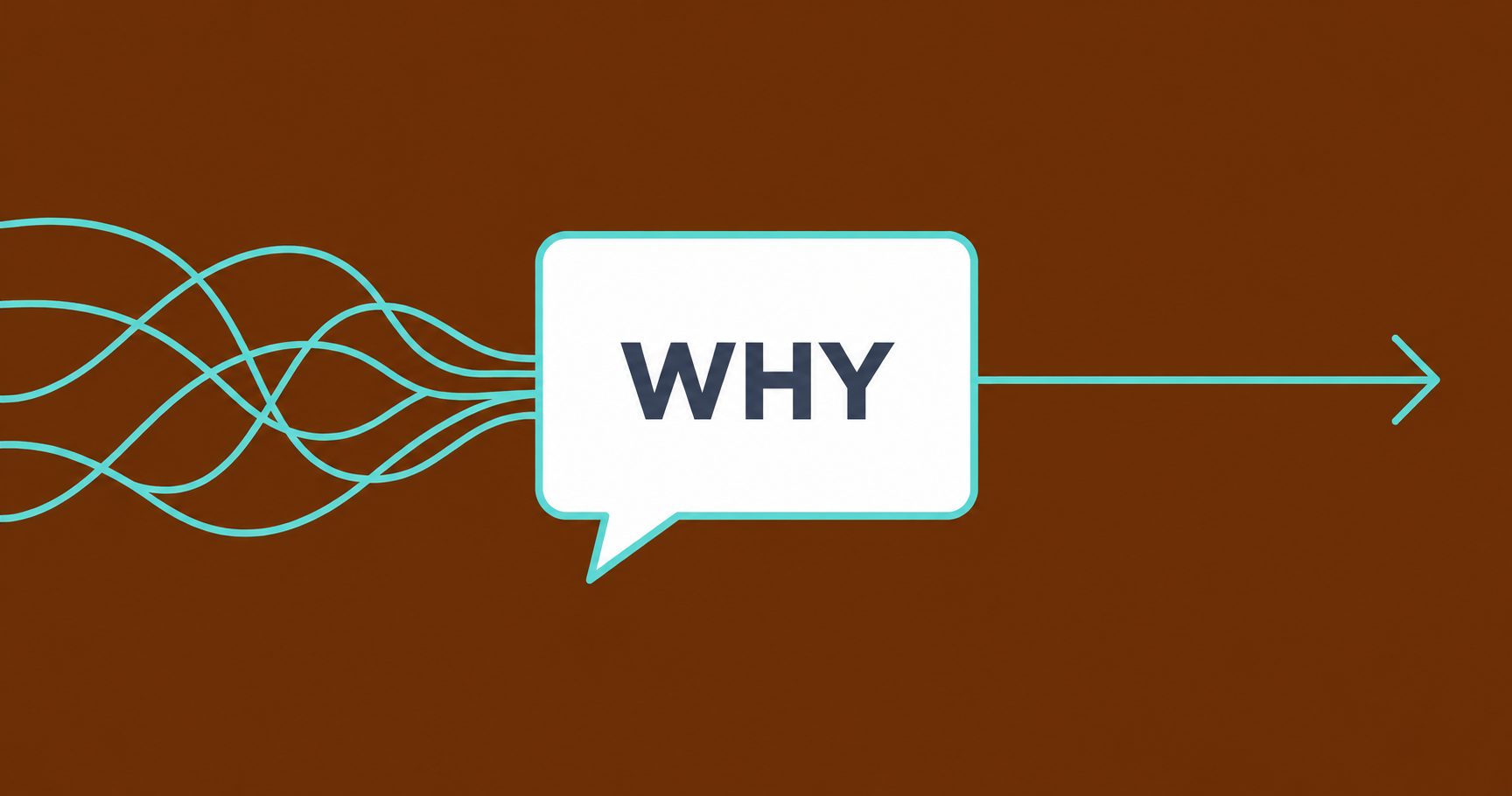
    Until I’m blue in the face, I will die on the hill that effective messaging and copywriting needs to be structured in a very deliberate “WHY→HOW→WHAT” hierarchy. In other words, if you want your message to resonate and achieve its objective, you simply MUST lead with WHY.

    But not your WHY…theirs!

    Nobody cares about your WHAT—or even your HOW —until you’ve connected to their WHY.

    The Power of Why is not just a viral TED Talk by Simon Sinek; it’s a proven model for messaging hierarchy that directly maps to the tried and true Sales Funnel framework. In other words, the model of “WHY→HOW→WHAT” is specifically engineered to nurture a potential customer into the action of your choosing…but in the time of the customer’s choosing. Because that’s who’s going to dictate the timing of a potential next step…not your urgent “call to action.”

    The WHY can be better understood when framed as a buying motivation. Most often (in the B2B world) that motivation is rooted in pain…sometimes it can be gain. But understand: before a potential customer ever reaches your doorstep, they are motivated by their own problems or aspirations — NOT the features of your product or service.

    So why ask WHY? Because that’s the mindset your coveted client is already in; and you need to map to it in order to emotionally connect with that prospect.

    AIDA, RACE and WHW

    Tom and Curtis go into three essential frameworks for marketing success on their Bullhorns and Bullseyes podcast. The first is the tried and true sales funnel, which follows a person from Awareness, through Interest and Desire, then ultimately to Action.

    The RACE model, created by Dr. Dave Chaffey, is about planning, measurement, and aligning tactics with funnel stages: Reach, Action, Conversion and Engagement. Note how each metric in the RACE framework directly maps to a stage in the AIDA model:

    When overlaid, it becomes obvious why you should lead with WHY, support that with HOW, and then deliver validating WHATs, our universally adopted framework for messaging, copywriting, and pretty much everything we do here at The Creative Mill.

    Listen + Look + Learn:

    Watch the entire episode below. Listen and subscribe to the audio podcast here. Check out the fuller explanation of the concepts explored in this episode via the Amplify and Aim newsletter below the video.

    https://youtube.com/watch?v=Ixj6QsUNKVU%3Ffeature%3Doembed

    🎯 Amplify and Aim Newsletter

    Episode Recap: Model Behavior

    This lesson in brief: “You Can’t Skip the Funnel—But You Can Equip It…Then You Should Flip It!”

    In this episode of Bullhorns and Bullseyes, Tom Nixon and Curtis Hays geek out (in the way that only true geeks dare!) on three powerful marketing models that shape how they plan campaigns, create content, and measure success. 

    If you’ve ever wondered why some campaigns flop while others convert like magic, this episode is your masterclass in doing it the Bullhorns and Bullseyes way—from the top of the funnel to the flip at the end.

    Let’s break it all down…

    ∇📊 MODEL #1: THE OG SALES FUNNEL (AIDA)

    First up: a classic. Tom reintroduces the trusty old AIDA sales funnel—Awareness, Interest, Desire, Action. Though it’s been around since the 19th century, too many marketers still get it wrong today by trying to skip straight to the sale. (Looking at you, “Buy Now” Facebook ads shown to total strangers.)

    The funnel represents the customer’s mindset—not just the steps they take. It’s linear, even if the journey increasingly isn’t. People move from not knowing you exist, to knowing you exist, to wanting what you offer, to finally buying it. But you can’t rush that process…or cheat it.

    Key Point: Most failed campaigns are a result of skipping the early steps—awareness and interest—and pushing for conversion way too early. Want to close more? Nurture more.

    🏃‍♂️📊 MODEL #2: THE RACE FRAMEWORK (REACH, ACT, CONVERT, ENGAGE)

    Next, Curtis shares a modern framework he’s been leaning on for nearly a decade: RACE, created by Dr. Dave Chaffey.

    Where AIDA is about mindset, RACE is about planning, measurement, and aligning tactics with funnel stages.

    • Reach = Build awareness. Don’t measure conversions here—measure impressions, traffic, and engagement.
    • Act = Spark exploration. This is where educational content shines and you begin building trust.
    • Convert = Now it’s time to push for leads or purchases. But only now.
    • Engage = Post-conversion, turn customers into advocates who drive future reach and help you flip the funnel.

    Curtis emphasizes that proper planning sits above the framework. How much budget goes to each stage depends on where you are today. A startup? You’ll need to invest heavily in awareness. A mature brand? You may be ready to convert.

    Key Point: The most efficient marketing spend aligns your budget, your tactics, and your metrics to the right stage of the funnel. Do it wrong, and you’re lighting money on fire.

    💬📝 MODEL #3: WHY→HOW→WHAT

    Finally, Tom rolls out his own spin on Simon Sinek’s Golden Circle—tailored for messaging. The core insight? You need to align with your audience’s why, not your company’s.

    Here’s how the model maps onto the funnel:

    • WHY: The emotional driver. Pain, aspiration, purpose. Start here to capture awareness.
    • HOW: Your method. This is what separates you from competitors and converts interest into desire.
    • WHAT: The features. This is what you do—but by the time someone is deciding that they want your WHATs, you’ve already won them over with the WHY and the HOW…because every competitor has your same WHAT, but not your HOW…and you can bet that they’ve skipped the all-important WHY altogether!

    Curtis admitted he used to get this backward—he thought “why” was about defining your brand’s purpose. Turns out, the real power lies in identifying your customer’s purpose and showing them how you help them fulfill it.

    Key Point: “Nobody cares how awesome your product is—until they know you understand what they’re going through from a pain or gain standpoint.”

    💡 PRO TIPS AND FAVORITE QUIPS

    • “You can’t skip the funnel—but you can equip the funnel. And then, you should flip the funnel.” —Tom
    • “Don’t engineer for awareness then measure conversions.” — Curtis
    • “Marketing should be viewed as an investment, not an expense. So spend wisely.” — Smart Consultants Everywhere
    • When you skip steps, you’re not just burning money—you’re forfeiting valuable trust along the way….and that’s a currency all its own!

    🧠🛠️ Why This Matters

    Marketers often focus on tactics—ads, blogs, email campaigns—without a framework to tie them together. What Tom and Curtis lay out here is a way to plan smarter, message more effectively, and measure in a way that aligns with reality…not your perfect dream world.

    Whether you’re a startup or a century-old brand, if you want better results from your marketing, you need to align what you’re doing with where your customers are in their journey.

    AND IF YOU WANT YOUR CAMPAIGNS TO ACTUALLY CONVERT? BE A MODEL CITIZEN…EXEMPLIFY MODEL BEHAVIORS…AND APPLY A PROVEN MODEL FOR SUCCESS!

    🎧 Listen or watch the full episode on your favorite platform or at bullhornsandbullseyes.com. Bonus: You’ll find downloadable visuals that map it all out. Subscribe to Amplify and Aim here.

    💥 Until next time: Keep blasting that bullhorn 📢 — and aiming for the bullseye 🎯‼️

  • Season 3, Episode 1: THE TRAP

    Season 3, Episode 1: THE TRAP

    The New Season of Bullhorns & Bullseyes Is Here. Let’s Talk About the Trap You’re Already In.

    “How did you go bankrupt?” Bill asked.

    “Two ways,” Mike said. “Gradually. And then suddenly.”

    That’s Hemingway. The Sun Also Rises. And it’s the best description I’ve found for what’s happening to marketing budgets right now.

    We’ve been quiet for four months. Not because Curtis and I ran out of opinions. Because we decided that if Season 3 were going to exist, it had to be something you could actually use. Not a collection of loosely connected conversations. A sequence. Eight episodes. Each one building on the last. Starting with this one. »

    By the end, you’ll have something that works whether you listen once or come back to it in a year.

    Think of Season 3 as an 16-week semester of higher education, with each episode serving both as a discrete learning module and as a sequential building block leading up to the final exam. There is a purposeful order to things this year. And we’re relying once again on some of the best and brightest minds in marketing and business development to help us advance the learning.

    It starts with the uncomfortable part.

    The wrong station, turned up loud. I used this analogy with Curtis during the episode and I want to share it here because I think it lands.

    Imagine your marketing is a radio. And the radio is stuck on country music. But your customer hates country. AI comes along and says: just turn it up. Louder. More channels. More volume. And all your customer is thinking is, this is not for me. Their inclination isn’t to listen harder. It’s to change the station.

    That’s the trap. Companies are spending more, producing more, deploying more. AI lets them do it all faster. And nobody is stopping to ask: are we even on the right station for the right listener?

    Curtis put it bluntly in the episode. He said it’s like calling IT because your network is down, and instead of checking whether the cable is plugged in, they replace the $50,000 server.

    He spent 15 years in IT before marketing, and the thing that drives him crazy is how quickly companies skip the simple diagnosis and jump straight to expensive solutions. You wouldn’t do that with a server. But companies do it with their marketing budget every single day.

    Mirror, Mirror…

    Here’s the part from the episode that I keep coming back to.

    Mirror, mirror on the wall, who’s the fairest of them all?

    You know the line. The queen asks the mirror. The mirror tells her exactly what she wants to hear. She’s pacified. Everything is fine. Until it isn’t. And when the truth finally shows up, she goes into a rage.

    That’s what most marketing looks like.

    Your homepage says “We are…” Your pitch deck leads with company history. Your AI tools polish that mirror until it gleams. And the mirror keeps telling you what you want to hear. You’re the fairest of them all. Your product is the best. Your differentiators are clear.

    But the customer is not in the mirror. The customer is on the other side of the window. And most companies haven’t actually looked through that window in a very long time.

    Curtis made a point that stopped me during our conversation. He said when you train AI without your customer’s reality, you’re just training it with the mirror. All it knows is your reflection. And a better reflection of yourself is not a reflection of your customer. Of course it’s going to tell you that you’re the fairest of them all.

    But does the customer care about that? Not yet…

    Nobody does this on purpose. It’s not vanity. It’s just the natural gravity of running a business. You know yourself. You talk about yourself. And gradually, then suddenly, you realize nobody’s listening.

    The Chaos Tax

    This is Curtis’s concept, and I’ll let him explain the math, because that’s what he does.

    You know what you pay for a lead. You might know your close rate. But do you know what you pay for a lead that actually becomes revenue? Not a form fill. A customer.

    The gap between those two numbers is what Curtis calls the Chaos Tax. It never shows up on a P&L. But it compounds. Every quarter you operate inside the trap, you’re not just wasting that quarter’s budget—you’re training your algorithms, your team, and your market to expect the wrong thing from you.

    AI makes the slope steeper. Not because AI is bad. Because AI is indifferent. It amplifies whatever you give it. If the inputs are wrong, you just waste money faster. With better production value.

    Going the wrong way. And making incredible time.

    Four Gates

    We laid down four principles in this episode. I’d call them sequence gates. You don’t get to skip ahead.

    Coherence before creativity. This one’s mine, so I’ll own it. I love the creative side of this business. But I can’t write a tagline that works if I don’t coherently understand what I’m being creative about. A beautiful message built on the wrong insight is just a beautiful mistake.

    Diagnosis before deployment. Curtis’s. He’s never going to let you spend money on ads before confirming your tracking works. Think of it like the IT help desk asking if you’ve rebooted. It’s annoying. It’s also the right first question. And, increasingly, he’s not going to let you deploy your campaigns until you’ve done the coherence work first.

    Meaning before media. Talk to five customers. Find the truth. Find what actually matters to them. Then go spend money on commercials and marketing. Not the other way around.

    Revenue before reach. Prove it converts before you scale it. The algorithms will find more people like the ones already buying. But only if you’ve done the work to know who those people are.

    Your Homework (that I know you won’t do, but should!)

    I’m giving you homework. I’m also betting exactly zero of you will do it. But here it is.

    Go have actual conversations with five customers. Ask them four questions:

    → What was life like before you even heard of us?

    → What pain made you go looking?

    → Why did you choose us? You could have chosen anyone.

    → How is your life different now that you’ve been working with us?

    If you do this, you’ll have the foundation for everything this season is going to teach you.

    If you skip it because you “already know the answers,” well. That’s the mirror talking.

    Two reasons people won’t do this:

    One, they’re afraid a customer might say something they don’t want to hear.

    Two, they’re convinced they already know what customers will say.

    Both of those are the trap. Both of them cost you money every quarter you avoid them.

    What’s on the Syllabus This Semester

    We didn’t offer a single solution in this episode. On purpose. This is the diagnosis. The indictment.

    Over the next eight episodes, Curtis and I are building the solution. The science behind why customers actually choose. How to excavate truth your customers won’t volunteer. How to turn that truth into a story that moves revenue. How to build a community that compounds. How to own your audience instead of renting it on platforms that can change the rules tomorrow.

    By the end, you’ll have a system. Not theory. Something you can run.

    But it starts here. With one honest question: When was the last time you actually talked to a customer? Not surveyed. Talked. And listened.

    If the answer is more than 90 days ago, you’re marketing from memory. Not reality.

    Watch or Listen to Season 3, Episode 1: THE TRAP

    Available on YouTube, Apple Podcasts, Spotify, and everywhere you listen.

    If this resonates, read the piece that started this whole arc: AI Isn’t Your Prophet. It Might Be Your Amplifier.

    Bullhorns & Bullseyes is hosted by Curtis Hays and Tom Nixon. Season 3 drops a new episode every two weeks.