
Category: Podcasting

  • Make Your Content Engine Purr

    Make Your Content Engine Purr

    A New Model for Content Marketing in 2026 and Beyond

    Two years ago, simply showing up was enough.

    If you published consistently, demonstrated expertise, and shared thoughtful perspectives over time, you separated yourself from most of the market. Content marketing worked because not everyone was doing it well — or doing it at all.

    Today, everyone is showing up.

    And most of them are using AI to do it.

    That doesn’t mean content marketing is dead. It means generic presence is dead. The problem isn’t volume. It’s believe-ability.

    We are no longer just competing with other professionals. We are competing with artificial voices, auto-generated expertise, and an endless stream of frictionless content. Even if your ideas are legitimate and human-generated, your audience may assume they aren’t. And if they believe they can prompt the same answer from ChatGPT in ten seconds, why should they read your blog post?

    That is the real shift.

    The End of Serial Publishing

    For years, the standard prescription looked like this: pick a topic, write a post, publish it, and repeat next week. Over time, that steady drumbeat built authority and brand preference. When someone eventually entered the market for your services, you were top of mind.

    In theory, that still works. In practice, it now produces something far less satisfying: invisibility.

    When every piece of content stands alone, when each post resets the clock, and when nothing builds toward a defined outcome, you are not creating momentum. You are maintaining motion. The difference matters.

    If 2026 demands anything of content marketers, it’s this: stop publishing serially and start building strategically.

    Instead of thinking in weekly posts, think in 90-day arcs. Instead of asking, “What should we write about this week?” ask, “What outcome are we driving toward this quarter?”

    Content without a defined destination is now just noise with grammar.

    The Four “Purrs”

    If your content strategy is going to cut through AI saturation and audience skepticism, it needs four deliberate characteristics. Together, they create what I call The Four “Purrs” — and ultimately, the fifth and most important result. (Spoiler alert: it also rhymes with purr.)

    1. Purposeful

    Content must be aimed. Not vaguely. Not aspirationally. Specifically.

    It’s no longer enough to say, “Over time, this will build trust.” The strategy should define a measurable objective inside a defined window — typically 90 days.

    For example: one clear purpose is to enroll as many members of your addressable market as possible into a live webinar, workshop, or in-person event. That singular objective changes how you create content. Each post becomes runway. Each video becomes reinforcement. Each email becomes part of a sequence.

    You begin to see your audience more clearly as well. There are learners who consume quietly. There are lurkers you cannot measure but know are there. And there are hand-raisers — the persuadable segment who are willing to take the next step.

    Your content must give them something to raise their hand to. Purpose creates direction. Direction creates momentum.

    2. Persistent

    Consistency used to be enough. Now it must be consistency with intention. Persistence is different: it’s consistency with purpose.

    Persistence means narrowing your focus over that 90-day arc. Instead of writing about a dozen disconnected topics, you select one core tension: one problem, one theme, one drumbeat …and you’re going to approach it persistently from multiple angles.

    You explore it through stories, analysis, examples, frameworks, and commentary. You repeat the central idea without repeating yourself. By the time your culminating event arrives, your audience should not wonder what it will cover. They should be expecting it.

    Persistence builds familiarity. Familiarity builds trust. Trust makes persuasion possible.

    3. Persuasive

    Education is valuable, but information alone is no longer scarce. Transformation is.

    Professional services are typically purchased at a moment of inflection — when someone decides they can no longer tolerate the status quo or they finally choose to pursue an aspiration. Effective content moves people closer to that decision.

    This does not require manipulation or aggressive selling. It requires clarity. Your content should demonstrate that the current path has limitations, that an alternative exists, and that you understand the emotional and practical tension your audience is experiencing.

    If your strategy is purposeful and persistent, persuasion becomes a natural byproduct. You are not pitching constantly; you are preparing thoughtfully. Over time, the persuadable segment of your audience begins to consider change.

    4. Personal

    This is where the human advantage becomes unmistakable.

    Written content alone now competes directly with AI. Machines will always win on speed and scale. Humans win on presence.

    Video. Live webinars. Unscripted commentary. Podcasts. Real conversations. When people see you think in real time, when they hear your cadence and observe nuance in your delivery, your expertise becomes authenticated. You signal authorship. You signal authenticity.

    In an era of synthetic content, visible humanity becomes a differentiator.

    Personal content does not replace written content. It validates it.

    The Fifth “Purr” → Permanence

    When content is purposeful, persistent, persuasive, and personal, something powerful happens: it gains permanence.

    Instead of disappearing into the feed after 24 hours, your ideas stay in the market for 90 days. They build anticipation toward a defined moment — a live event, a webinar, a workshop, or a briefing.

    That event then becomes fuel for the next 90 days.

    You record it. You gate the replay. You extract short-form video clips. You generate companion blog posts. You develop follow-up emails. You create derivative assets that extend the lifecycle of a single idea.

    Your strategy compounds rather than resets.

    You are no longer producing isolated posts. You are programming reputation over time.

    The New Discipline

    The truth is, AI did not kill content marketing. It exposed outdated strategy.

    The brands that will win in 2026 and beyond will not be the ones producing the most content. They will be the ones building structured, human, outcome-driven arcs that culminate in meaningful engagement.

    The question is no longer, “What should we publish this week?”

    It is, “What are we building toward over the next 90 days?”

    Answer that well, and your content engine won’t sputter.

    It will purr.

    .

  • Mapping the Hero’s Journey

    Mapping the Hero’s Journey

    Your Customer is the Hero, Not You

    How familiar are you with Joseph Campbell’s now classic framework, “the hero’s journey?” You may not know it intimately, but if you’ve ever seen Star Wars, you’ve seen it in action.

    But it’s also central to effective content marketing strategy. Let’s explore…

    In summary, Campbell outlined the journey of a hero as a person living an ordinary life, but perhaps with an extraordinary gift or tragic event. As a result, they are called to adventure. So begins a journey. At the end, a happy resolution and a mission fulfilled.

    Back to Star Wars as the example, George Lucas tells the story of Luke Skywalker, the lowly farmer who discovers the force after his village and family are destroyed. That call to adventure — vengeance against the evildoers — leads to trials, transformation, and eventually a restored outcome.

    So how does that map to marketing?

    Followers of Campbell’s work point out, correctly, that customer is the hero in their journey, not the brand trying to sell that hero a product or service. When done effectively, the brand acts as the guide, the mentor, the path to resolution.

    Think of Obi-Wan Kenobi or Han Solo guiding Luke Skywalker; you’re helping the customer along their path. Kenobi provides education and a weapon. Han Solo transports Luke across the galaxy. They facilitate the hero; they don’t try to become the hero.

    Likewise, you shouldn’t be thinking first and foremost about selling a product. Primarily, we should relate to the customer’s problem and work to guide them towards a solution, ultimately achieving their desired outcome — which just happens to be your own.

    If we’re truly putting the customer at the center, seeing them as the hero, how do we effectively map out their journey? Let’s continue along on our journey…

    Mapping the Hero’s Journey

    Once you understand their hero’s aspiration, that emotional trigger that prompts their call to adventure, that feeling that says, “I can’t live like this anymore. I need a solution,” you can begin to articulate that you understand the hero’s motivation. That’s the WHY.

    After the WHY comes the HOW. This is when customers start looking for solutions, and if you’ve connected with them on a WHY level, you have them as an audience, and they will naturally look and wonder, “How will you solve my problem?” 

    In Luke Skywalker’s case, he asks Obi-Wan. “You fought in the clone wars?” Which translates to, you’ve been in my shoes? Obi-Wan then presents Luke with his father’s lightsaber. Here’s a tool that might help you solve your problem. You could use a blaster, (i.e., a competitor). But this lightsaber here is the more “elegant” solution.

    Now Obi-Wan has Luke’s attention. He starts educating. “For a thousand years, the Jedi Knights were the guardians of peace and justice in the Old Republic….”

    As the conversation moves on, Luke wants to learn more about the force. He’s drawn completely into his new mentor. Obi-Wan has an audience…a disciple, even.

    Then comes the WHAT.  At the core, it’s the specific products, services, or actions your organization offers. It’s what you do or sell. The light saber is the WHAT. But Luke would never go looking for one if he didn’t have a truly motivational WHY.

    The Whats look almost indistinguishable from competitors’, feature for feature. But if a company connects deeply on the WHY and offers a truly differentiated HOW, then the WHAT, the actual purchase, becomes almost a given. Price becomes less of a factor because you’ve already built that foundational trust and connection.

    Use the Force (of Effective Content)

    Obi-Wan played the long game. He lurked in the shadows, making himself known to his audience for when the time was right. Luke was “in market” when he was called to his adventure. 

    That’s the crucial point of content marketing: it isn’t just about immediate sales. It’s about demonstrating expertise, establishing authority and gaining trust before a customer is actively looking, so you’re top of mind when they do need you precisely. Luke sought out “Old Ben.”  You want your brand to be known as the expert. When a problem does eventually arise, you’re the first one they think of. Which you could say is definitely playing the long game.

    So, what kinds of content actually work best for this long-game approach?

    Well, you tailor it to that hero’s journey. You tell stories. You use case studies, you educate, you hit them with content at different stages of the journey where those potential customers are on their learning and decision-making path.

    Your ultimate goal with content is building an audience of loyal fans who can’t wait for your next piece of content, your next product or feature.

    Fans of brands don’t need a hard sell. When the next iPhone is released, people will wait in line for hours to purchase their new device. Not just because it has a better camera or a faster processor. They could get that from Android. They buy from Apple because somewhere along the way, Apple established a level of loyalty and deep connection with an audience of true fans who couldn’t be pried away from the brand.

    What would that level of loyalty and deep connection look like for your brand?

    It’s a powerful idea to consider. Even more powerful to implement. 

    Listen and Learn

    In this latest Episode of Bullhorns & Bullseyes, Tom Nixon and Curtis Hays focus on something foundational to effective content deployment: Marketing isn’t about who can shout louder or who can outspend the competitive field in the arena of advertising. It’s about genuinely understanding your customers, aligning with their journey, and becoming part of their story. Not as the hero. As the helpful guide that gets them where they need to go.

    As you rethink your own approach to content marketing, ask yourself, who’s the true hero in your story?

    ▶️ Watch On YouTube: https://youtu.be/ab9-fIl1-SM

    🎧 Listen On Spotify: https://open.spotify.com/show/5Qxv2Vr2lCPmhM4aiF3KAN

    🙏 Please Support Bullhorns & Bullseyes: Like, share, comment, & subscribe!

  • Map Messaging to Measurement

    Map Messaging to Measurement

    Model Behavior

    At first, most people don’t get it. But once it clicks, it becomes the most powerful methodology for messaging, marketing and media itself.

    By “it,” I’m referring to “WHY.”

    Until I’m blue in the face, I will die on the hill that effective messaging and copywriting needs to be structured in a very deliberate “WHY→HOW→WHAT” hierarchy. In other words, if you want your message to resonate and achieve its objective, you simply MUST lead with WHY.

    But not your WHY…theirs!

    Nobody cares about your WHAT—or even your HOW —until you’ve connected to their WHY.

    The Power of Why is not just a viral TED Talk by Simon Sinek; it’s a proven model for messaging hierarchy that directly maps to the tried and true Sales Funnel framework. In other words, the model of “WHY→HOW→WHAT” is specifically engineered to nurture a potential customer into the action of your choosing…but in the time of the customer’s choosing. Because that’s who’s going to dictate the timing of a potential next step…not your urgent “call to action.”

    The WHY can be better understood when framed as a buying motivation. Most often (in the B2B world) that motivation is rooted in pain…sometimes it can be gain. But understand: before a potential customer ever reaches your doorstep, they are motivated by their own problems or aspirations — NOT the features of your product or service.

    So why ask WHY? Because that’s the mindset your coveted client is already in; and you need to map to it in order to emotionally connect with that prospect.

    AIDA, RACE and WHW

    Tom and Curtis go into three essential frameworks for marketing success on their Bullhorns and Bullseyes podcast. The first is the tried and true sales funnel, which follows a person from Awareness, through Interest and Desire, then ultimately to Action.

    The RACE model, created by Dr. Dave Chaffey, is about planning, measurement, and aligning tactics with funnel stages: Reach, Action, Conversion and Engagement. Note how each metric in the RACE framework directly maps to a stage in the AIDA model:

    When overlaid, it becomes obvious why you should lead with WHY, support that with HOW, and then deliver validating WHATs, our universally adopted framework for messaging, copywriting, and pretty much everything we do here at The Creative Mill.

    Listen + Look + Learn:

    Watch the entire episode below. Listen and subscribe to the audio podcast here. Check out the fuller explanation of the concepts explored in this episode via the Amplify and Aim newsletter below the video.

    https://youtube.com/watch?v=Ixj6QsUNKVU%3Ffeature%3Doembed

    🎯 Amplify and Aim Newsletter

    Episode Recap: Model Behavior

    This lesson in brief: “You Can’t Skip the Funnel—But You Can Equip It…Then You Should Flip It!”

    In this episode of Bullhorns and Bullseyes, Tom Nixon and Curtis Hays geek out (in the way that only true geeks dare!) on three powerful marketing models that shape how they plan campaigns, create content, and measure success. 

    If you’ve ever wondered why some campaigns flop while others convert like magic, this episode is your masterclass in doing it the Bullhorns and Bullseyes way—from the top of the funnel to the flip at the end.

    Let’s break it all down…

    ∇📊 MODEL #1: THE OG SALES FUNNEL (AIDA)

    First up: a classic. Tom reintroduces the trusty old AIDA sales funnel—Awareness, Interest, Desire, Action. Though it’s been around since the 19th century, too many marketers still get it wrong today by trying to skip straight to the sale. (Looking at you, “Buy Now” Facebook ads shown to total strangers.)

    The funnel represents the customer’s mindset—not just the steps they take. It’s linear, even if the journey increasingly isn’t. People move from not knowing you exist, to knowing you exist, to wanting what you offer, to finally buying it. But you can’t rush that process…or cheat it.

    Key Point: Most failed campaigns are a result of skipping the early steps—awareness and interest—and pushing for conversion way too early. Want to close more? Nurture more.

    🏃‍♂️📊 MODEL #2: THE RACE FRAMEWORK (REACH, ACT, CONVERT, ENGAGE)

    Next, Curtis shares a modern framework he’s been leaning on for nearly a decade: RACE, created by Dr. Dave Chaffey.

    Where AIDA is about mindset, RACE is about planning, measurement, and aligning tactics with funnel stages.

    • Reach = Build awareness. Don’t measure conversions here—measure impressions, traffic, and engagement.
    • Act = Spark exploration. This is where educational content shines and you begin building trust.
    • Convert = Now it’s time to push for leads or purchases. But only now.
    • Engage = Post-conversion, turn customers into advocates who drive future reach and help you flip the funnel.

    Curtis emphasizes that proper planning sits above the framework. How much budget goes to each stage depends on where you are today. A startup? You’ll need to invest heavily in awareness. A mature brand? You may be ready to convert.

    Key Point: The most efficient marketing spend aligns your budget, your tactics, and your metrics to the right stage of the funnel. Do it wrong, and you’re lighting money on fire.

    💬📝 MODEL #3: WHY→HOW→WHAT

    Finally, Tom rolls out his own spin on Simon Sinek’s Golden Circle—tailored for messaging. The core insight? You need to align with your audience’s why, not your company’s.

    Here’s how the model maps onto the funnel:

    • WHY: The emotional driver. Pain, aspiration, purpose. Start here to capture awareness.
    • HOW: Your method. This is what separates you from competitors and converts interest into desire.
    • WHAT: The features. This is what you do—but by the time someone is deciding that they want your WHATs, you’ve already won them over with the WHY and the HOW…because every competitor has your same WHAT, but not your HOW…and you can bet that they’ve skipped the all-important WHY altogether!

    Curtis admitted he used to get this backward—he thought “why” was about defining your brand’s purpose. Turns out, the real power lies in identifying your customer’s purpose and showing them how you help them fulfill it.

    Key Point: “Nobody cares how awesome your product is—until they know you understand what they’re going through from a pain or gain standpoint.”

    💡 PRO TIPS AND FAVORITE QUIPS

    • “You can’t skip the funnel—but you can equip the funnel. And then, you should flip the funnel.” —Tom
    • “Don’t engineer for awareness then measure conversions.” — Curtis
    • “Marketing should be viewed as an investment, not an expense. So spend wisely.” — Smart Consultants Everywhere
    • When you skip steps, you’re not just burning money—you’re forfeiting valuable trust along the way….and that’s a currency all its own!

    🧠🛠️ Why This Matters

    Marketers often focus on tactics—ads, blogs, email campaigns—without a framework to tie them together. What Tom and Curtis lay out here is a way to plan smarter, message more effectively, and measure in a way that aligns with reality…not your perfect dream world.

    Whether you’re a startup or a century-old brand, if you want better results from your marketing, you need to align what you’re doing with where your customers are in their journey.

    AND IF YOU WANT YOUR CAMPAIGNS TO ACTUALLY CONVERT? BE A MODEL CITIZEN…EXEMPLIFY MODEL BEHAVIORS…AND APPLY A PROVEN MODEL FOR SUCCESS!

    🎧 Listen or watch the full episode on your favorite platform or at bullhornsandbullseyes.com. Bonus: You’ll find downloadable visuals that map it all out. Subscribe to Amplify and Aim here.

    💥 Until next time: Keep blasting that bullhorn 📢 — and aiming for the bullseye 🎯‼️

  • Season 3, Episode 1: THE TRAP

    Season 3, Episode 1: THE TRAP

    The New Season of Bullhorns & Bullseyes Is Here. Let’s Talk About the Trap You’re Already In.

    “How did you go bankrupt?” Bill asked.

    “Two ways,” Mike said. “Gradually. And then suddenly.”

    That’s Hemingway. The Sun Also Rises. And it’s the best description I’ve found for what’s happening to marketing budgets right now.

    We’ve been quiet for four months. Not because Curtis and I ran out of opinions. Because we decided that if Season 3 were going to exist, it had to be something you could actually use. Not a collection of loosely connected conversations. A sequence. Eight episodes. Each one building on the last. Starting with this one. »

    By the end, you’ll have something that works whether you listen once or come back to it in a year.

    Think of Season 3 as an 16-week semester of higher education, with each episode serving both as a discrete learning module and as a sequential building block leading up to the final exam. There is a purposeful order to things this year. And we’re relying once again on some of the best and brightest minds in marketing and business development to help us advance the learning.

    It starts with the uncomfortable part.

    The wrong station, turned up loud. I used this analogy with Curtis during the episode and I want to share it here because I think it lands.

    Imagine your marketing is a radio. And the radio is stuck on country music. But your customer hates country. AI comes along and says: just turn it up. Louder. More channels. More volume. And all your customer is thinking is, this is not for me. Their inclination isn’t to listen harder. It’s to change the station.

    That’s the trap. Companies are spending more, producing more, deploying more. AI lets them do it all faster. And nobody is stopping to ask: are we even on the right station for the right listener?

    Curtis put it bluntly in the episode. He said it’s like calling IT because your network is down, and instead of checking whether the cable is plugged in, they replace the $50,000 server.

    He spent 15 years in IT before marketing, and the thing that drives him crazy is how quickly companies skip the simple diagnosis and jump straight to expensive solutions. You wouldn’t do that with a server. But companies do it with their marketing budget every single day.

    Mirror, Mirror…

    Here’s the part from the episode that I keep coming back to.

    Mirror, mirror on the wall, who’s the fairest of them all?

    You know the line. The queen asks the mirror. The mirror tells her exactly what she wants to hear. She’s pacified. Everything is fine. Until it isn’t. And when the truth finally shows up, she goes into a rage.

    That’s what most marketing looks like.

    Your homepage says “We are…” Your pitch deck leads with company history. Your AI tools polish that mirror until it gleams. And the mirror keeps telling you what you want to hear. You’re the fairest of them all. Your product is the best. Your differentiators are clear.

    But the customer is not in the mirror. The customer is on the other side of the window. And most companies haven’t actually looked through that window in a very long time.

    Curtis made a point that stopped me during our conversation. He said when you train AI without your customer’s reality, you’re just training it with the mirror. All it knows is your reflection. And a better reflection of yourself is not a reflection of your customer. Of course it’s going to tell you that you’re the fairest of them all.

    But does the customer care about that? Not yet…

    Nobody does this on purpose. It’s not vanity. It’s just the natural gravity of running a business. You know yourself. You talk about yourself. And gradually, then suddenly, you realize nobody’s listening.

    The Chaos Tax

    This is Curtis’s concept, and I’ll let him explain the math, because that’s what he does.

    You know what you pay for a lead. You might know your close rate. But do you know what you pay for a lead that actually becomes revenue? Not a form fill. A customer.

    The gap between those two numbers is what Curtis calls the Chaos Tax. It never shows up on a P&L. But it compounds. Every quarter you operate inside the trap, you’re not just wasting that quarter’s budget—you’re training your algorithms, your team, and your market to expect the wrong thing from you.

    AI makes the slope steeper. Not because AI is bad. Because AI is indifferent. It amplifies whatever you give it. If the inputs are wrong, you just waste money faster. With better production value.

    Going the wrong way. And making incredible time.

    Four Gates

    We laid down four principles in this episode. I’d call them sequence gates. You don’t get to skip ahead.

    Coherence before creativity. This one’s mine, so I’ll own it. I love the creative side of this business. But I can’t write a tagline that works if I don’t coherently understand what I’m being creative about. A beautiful message built on the wrong insight is just a beautiful mistake.

    Diagnosis before deployment. Curtis’s. He’s never going to let you spend money on ads before confirming your tracking works. Think of it like the IT help desk asking if you’ve rebooted. It’s annoying. It’s also the right first question. And, increasingly, he’s not going to let you deploy your campaigns until you’ve done the coherence work first.

    Meaning before media. Talk to five customers. Find the truth. Find what actually matters to them. Then go spend money on commercials and marketing. Not the other way around.

    Revenue before reach. Prove it converts before you scale it. The algorithms will find more people like the ones already buying. But only if you’ve done the work to know who those people are.

    Your Homework (that I know you won’t do, but should!)

    I’m giving you homework. I’m also betting exactly zero of you will do it. But here it is.

    Go have actual conversations with five customers. Ask them four questions:

    → What was life like before you even heard of us?

    → What pain made you go looking?

    → Why did you choose us? You could have chosen anyone.

    → How is your life different now that you’ve been working with us?

    If you do this, you’ll have the foundation for everything this season is going to teach you.

    If you skip it because you “already know the answers,” well. That’s the mirror talking.

    Two reasons people won’t do this:

    One, they’re afraid a customer might say something they don’t want to hear.

    Two, they’re convinced they already know what customers will say.

    Both of those are the trap. Both of them cost you money every quarter you avoid them.

    What’s on the Syllabus This Semester

    We didn’t offer a single solution in this episode. On purpose. This is the diagnosis. The indictment.

    Over the next eight episodes, Curtis and I are building the solution. The science behind why customers actually choose. How to excavate truth your customers won’t volunteer. How to turn that truth into a story that moves revenue. How to build a community that compounds. How to own your audience instead of renting it on platforms that can change the rules tomorrow.

    By the end, you’ll have a system. Not theory. Something you can run.

    But it starts here. With one honest question: When was the last time you actually talked to a customer? Not surveyed. Talked. And listened.

    If the answer is more than 90 days ago, you’re marketing from memory. Not reality.

    Watch or Listen to Season 3, Episode 1: THE TRAP

    Available on YouTube, Apple Podcasts, Spotify, and everywhere you listen.

    If this resonates, read the piece that started this whole arc: AI Isn’t Your Prophet. It Might Be Your Amplifier.

    Bullhorns & Bullseyes is hosted by Curtis Hays and Tom Nixon. Season 3 drops a new episode every two weeks.

  • That’s a Wrap!

    That’s a Wrap!

    Lessons Learned from Season 2 of Bullhorns and Bullseyes

    Curtis and I wrapped the final episode of Bullhorns & Bullseyes this week. We broke some news, reflected on lessons learned, celebrated a star-studded roster of guests, and pledged to do something a little different and daring next year. And we hope you’ll be a part of it!

    One of the themes from Season 2 was the concept of storytelling. This time of year you see it everywhere you look:

    ‣ Seasonal nostalgia
    ‣ Stories that tug at the heart strings
    ‣ Vignettes that keep you longing for yesteryear
    ‣ Tearjerkers you kick yourself for falling for

    These aren’t advertisements…they’re brand builders. And they’re more effective and memorable than the 11 months prior pushing sales and promotions combined.

    Think about it: When you get caught up in a story, you can’t help but stick around to see how it ends. When’s the last time a commercial pushing 15% off accomplished that much? Something to consider for 2026….more on that to come.

    Until then, check out the episode below, find it and subscribe here, and read all about it below the video!

    About Last Week…

    75 Episodes, Two Seasons, One Big Realization

    We never set out to build a marketing community. We just wanted to tell Mario’s story.

    But here we are, wrapping up Season 2 of Bullhorns & Bullseyes with 75 episodes behind us, a roster of marketing legends as guests, and something we didn’t expect: proof that authentic expertise shared consistently builds something bigger than a podcast.

    It builds authority. It builds relationships. It builds business.

    How It All Started

    Two years ago, Curtis asked Tom to write a case study about their 7-year relationship with Mario D’Aquila’s Assisted Living Home Care Services.

    Tom called back with a different idea: “Their journey is so detailed, I don’t think a case study can capture it all. Let’s tell the story on a podcast.”

    That conversation launched Bullhorns & Bullseyes. The first three episodes were Mario’s marketing transformation story.

    Now Mario’s appeared 5 times out of 75 episodes and just announced he’s starting his own podcast. The student becomes the teacher.

    The Unexpected Guest List

    What started as one client’s story became something we couldn’t have predicted. Season 2 alone featured:

    Marketing legends: Mark Schaefer on AI and humanity, Brian Clark on content marketing evolution, Gini Dietrich with the PESO model

    Industry innovators: Jesse Flores on the future of AI agents, Janet Tyler on agency transformation

    Storytelling experts: Kristian Alomá on narrative psychology and customer interviews

    Privacy attorneys, acquisition specialists, and business builders who shared practical insights you can’t find anywhere else

    Tom called it “a who’s who list of heavy hitters in the marketing industry.” But here’s what we learned: they didn’t come on because we’re famous. They came on because we’re genuinely curious about what works.

    The AI Thread That Ran Through Everything

    Season 2 became accidentally prophetic about AI’s impact on marketing.

    Mark Schaefer showed us how to add humanity to AI tools without losing efficiency. Jesse Flores painted a picture of an agentic web where websites become conversation partners. Gini Dietrich explained how AI search is changing the discovery process entirely.

    But the real insight came from Brian Clark: “Expertise and wisdom combined with AI is the secret component.”

    The marketers winning aren’t the ones avoiding AI or blindly embracing it. They’re the ones using AI to amplify their hard-won expertise and human judgment.

    The Tractor Story That Explained Everything

    Sometimes the best marketing insights come from the most unexpected places. Curtis’s story about buying a $35 tractor gas nozzle became the perfect example of how modern customer journeys really work.

    He saw a Facebook ad. Got a coupon but wasn’t ready. Watched organic YouTube reviews. Waited for the right color to come in stock. Eventually bought direct from the website.

    Zero attribution in any traditional system. Perfect customer journey in reality.

    Gini called it “a perfect PESO model customer journey” – paid advertising, earned reviews, shared social proof, and owned conversion path all working together.

    The lesson: Stop trying to control the customer journey. Start being present everywhere it might happen.

    What We Learned About Authority

    Here’s what 75 episodes taught us about building business authority:

    Consistency beats perfection. We missed some weeks. We had technical issues. But we kept showing up with valuable conversations.

    Questions matter more than answers. The best episodes weren’t lectures. They were explorations of real problems with people who’ve solved them.

    Stories stick better than strategies. Curtis’s tractor purchase taught attribution better than any framework. Mario’s journey showed DISC assessments in action better than any theory.

    Community builds itself. We didn’t set out to build a marketing community. We just kept having interesting conversations with smart people. The community formed around shared curiosity.

    The Business Impact We Didn’t Expect

    Neither Curtis nor Tom planned for podcasting to become a business strategy. But here’s what happened:

    Relationship acceleration: Guests became partners, advisors, and friends faster than traditional networking ever achieved

    Authority establishment: Industry leaders started referencing episodes in their own content and keynote presentations

    Business development: The conversations opened doors to opportunities that cold outreach never could

    Knowledge consolidation: Teaching forced deeper understanding of concepts both hosts thought they already knew

    Mario put it perfectly: “I actually hear a lot of folks say, ‘Oh my God, you work with Curtis? You work with Tom Nixon?’ So there’s something to this podcasting.”

    The Season 3 Tease

    Curtis revealed they’re working on something different for Season 3 – possibly a mini-course format that goes deeper on specific topics rather than just interview-style episodes.

    And yes, there will be a new hat. Curtis is taking his daughter shopping at “the Boot Barn” to find the perfect Season 3 headwear.

    Some things change. Some things stay the same.

    The Gratitude List

    Both hosts emphasized gratitude as they wrapped Season 2. Not just for guests who shared their time and expertise, but for listeners who engaged, shared, and applied what they learned.

    Tom’s reflection: “Thank you to the listeners and viewers and commenters. We appreciate it and you’ll have more opportunity to comment and let your voice be heard next season.”

    The podcast became a dialogue, not a monologue. That’s what made it work.

    What This Means for Your Business

    The Bullhorns & Bullseyes experiment proves something important: In an attention economy, the businesses that win are the ones that earn attention by genuinely serving their audience.

    Not with slick production values or celebrity guests, but with consistent curiosity about real problems and real solutions.

    The framework isn’t complicated:

    • Find topics your ideal customers actually care about

    • Have honest conversations with people who’ve solved those problems

    • Share insights without holding back the best stuff

    • Show up consistently, even when it’s inconvenient

    • Trust that authority builds itself when you focus on serving others

    Curtis and Tom didn’t set out to become marketing authorities. They just kept asking good questions and sharing what they learned.

    Two seasons and 75 episodes later, they’ve built something that generates business, creates relationships, and serves a community.

    All by deciding to tell one client’s story and never stopping the conversation.

    The Season 3 Promise

    The announcement is clear: they’re coming back with sponsors, new formats, and continued commitment to practical marketing insights you can actually use.

    But the real promise is the same one they’ve kept for 75 episodes: show up with curiosity, share what works, and trust that serving your audience well creates business results.

    Season 3 launches with new energy, new formats, and the same commitment to honest conversations about marketing that actually works.

    The question isn’t whether you should start your own podcast. The question is: What expertise could you share consistently that would serve your ideal customers?

    The Bullhorns & Bullseyes story shows that when you focus on serving others with what you know, everything else follows.

    See you all on the flip side!

  • Podcast: That’s a Wrap!

    Podcast: That’s a Wrap!

    40 Episodes of Bullhorns and Bullseyes

    My co-host, Curtis Hayes, and I put the wraps on the first season of our Bullhorns and Bullseyes podcast recently, recapping the big takeaways and lessons learned from our guests during the first 40 episodes…

    Watch:

    In a Nutshell

    The first season followed a general story arch that looked something like this:

    1.) Why—>How—>What

    The importance of messaging hierarchy.

    2.) Mutual Accountability

    The role of systems in marketing and how to bring both departments together.

    3.) What Gets Measured Gets Done

    The necessity of aligning metrics with objectives. (Hint: Not everything should be measured as pass/fail.)

    Specific Takeaways:

    • Reflecting on the journey of the podcast and its evolution.

    • How does “WHY-HOW-WHAT” align with the “AIDA” sales funnel?

    • The importance of KPIs in measuring marketing success.

    • Sales readiness is crucial for converting leads into customers.

    • How to align metrics with messaging and methodologies to maximize marketing efforts.

    • Brand building is essential for long-term business growth and short-term lead generation.

    • Sales training can significantly improve conversion rates.

    • Aligning marketing and sales efforts is key to success.

    • Budget allocation should reflect the sales funnel stages and map to the desired outcome of each stage…not JUST sales or conversions!

    Stay Tuned

    Be sure to subscribe on the platform of your choosing, so you can pick up with us right where we left off. Season Two is already in the works!

  • Let Content Be Your Praise Singer

    You Don’t Have to Be in the Room to Gain Influence

    Adrian Lurssen tells the story of when he went to see Nelson Mandela deliver an address in his home country of South Africa. He still draws upon the experience today, but in the most unusual context.

    Co-founder of JD Supra, a digital media company that enables professionals to greatly increase their visibility by sharing their expertise online, Adrian recalls seeing firsthand as a child something he was not at all familiar with. Prior to Mandela’s oratory, there emerged on stage a man dressed in tribal attire, singing a song in a native dialect. Adrian leaned over to his father, who had brought Adrian to the event, and asked him what this man was doing or saying.

    His father explained to Adrian, “That is Nelson Mandela’s praise singer. He has come out in advance of Mr. Mandela to tell the crowd how special Nelson is…to explain on Mr. Mandela’s behalf how wonderful his ideas and thoughts are, as soon to be expressed by the man himself. He’s literally singing his praises.”

    [Now you know where that expression comes from, if you didn’t already.]

    As Adrian recounts this tale to Jay Harrington and me on an episode of The Thought Leadership Project podcast, he likens this notion of a praise singer to how we considers thought leadership content to work on behalf of the expert that shares it.

    What Does This Have to Do with Content?

    In Adrian’s estimation — one I happen to share — thought leadership content serves in the capacity of being one’s praise singer. It exists out in the world to tell everyone how smart you are, what you know, what you think, what you can do, how you solve problems. “It sings your praises,” Adrian notes, “even when you’re not there in the room to do it yourself.”

    This is the problem (and the potential) for expertise that remains locked in one’s own mind, protected from the world it can serve, and held close to the chest. Ideas and solutions are what the market is looking for, whether you’re in the room to peddle them or not.

    You can’t be everywhere at once, but your thought leadership content literally can. If you trust the process, even when you can’t open a dashboard to witness firsthand vanity metrics and analytics, you’ll keep at it with the necessary discipline and optimism. Then, almost by magic, people start noticing. They start mentioning. They tell you they’ve been following along. That they hold you in high esteem. And, curiously, they or someone they know wants to hire you. Amazing how that works. 

    Unleash your praise singer. Generously share your ideas with the world. Let people know how wise and capable you are, just as a praise singer would do for you, were you the likes of Nelson Mandela himself.

    It’s okay to sing your own praises, if that’s how you want to consider it. But when you’re sharing expertise and solving problems for others, that doesn’t come across as self-service. It gets received as thought leadership.

    By the time you arrive “in the room” to make a pitch, close a sale, or entice a prospect, your praise singer will have done most of the work for you. And it’s entirely likely that the only person yet to come on stage will be you — not your competitors, the invisible and anonymous orators working without the benefit of a praise singer.

  • Podcast: LinkedIn Mastery

    Podcast: LinkedIn Mastery

    Bullhorns + Bullseyes Meets The Thought Leadership Project

    It’s the crossover event of the season! Well, maybe.

    Jay Harrington from The Thought Leadership Project joined Curtis Hays on the Bullhorns and Bullseyes podcast recently. And I’m caught in the middle making sure nobody’s candy bar drops into anyone’s peanut butter!

    Topic: LinkedIn Mastery, both from a content creation standpoint and from an advertising perspective.

    Jay and Curtis each have unique and valuable insights to share, presenting what I think is the perfect world for LinkedIn mastery: organic reach and targeted advertising.

    📢 ➕ 🎯 🟰 🏆

    Useful Links:

    Listen now, or find it on the podcasting platform of your preference here:

    Details, video, transcript and more here.

    Sneak peek:

    Show notes:

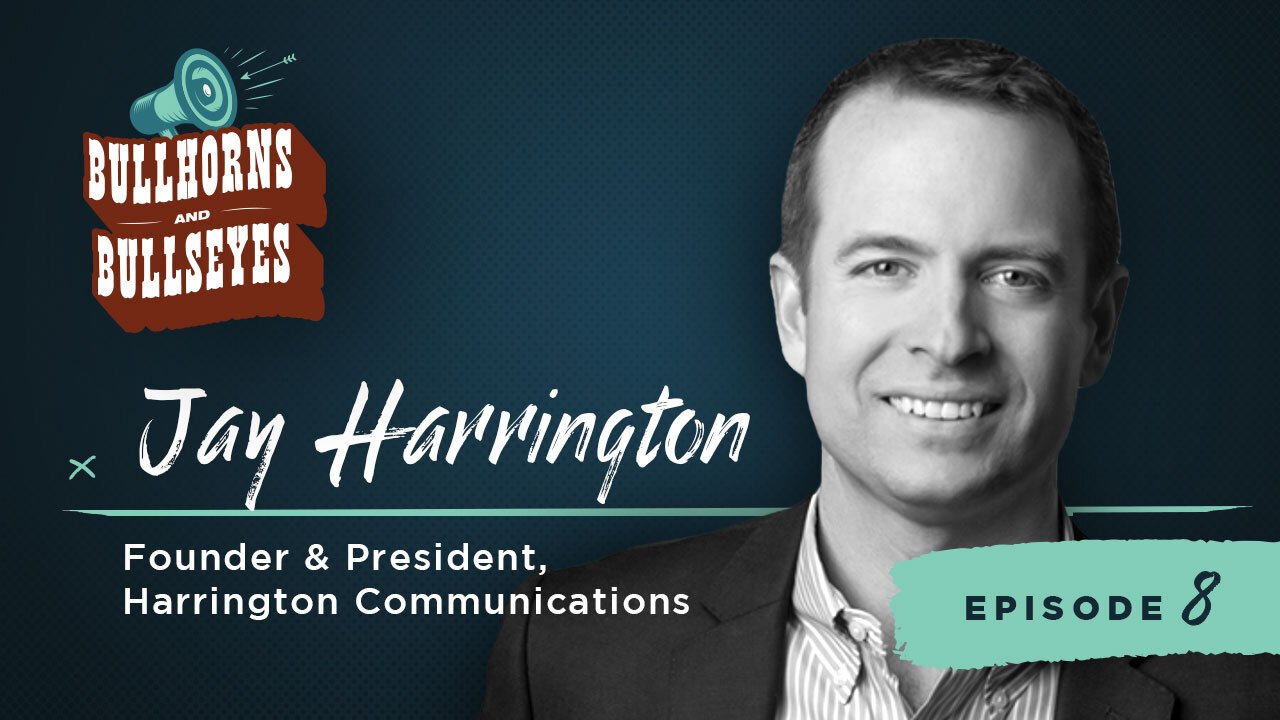
    Jay Harrington is president of the HARRINGTON agency and is one of the country’s leading consultants and strategists in the areas of legal marketing, PR and business development. His particular passion and profound area of expertise is building a network and growing an audience on LinkedIn to generate more and better new business opportunities.

    In this podcast crossover event — Tom and Jay also separately co-host the Thought Leadership Project podcast — Curtis and they discuss tips for publishing thought leadership and content marketing on LinkedIn.
    Together, they explore the engagement metrics on the platform and the effectiveness of using LinkedIn as an advertising platform. They also highlight the importance of understanding your audience and narrowing your niche, as well as the need for sustained effort and consistency in creating thought leadership content on LinkedIn.

    Takeaways:

    • Thought leadership and content marketing are effective strategies for growing networks, building reputation, and earning trust on LinkedIn.

    • Engagement metrics on LinkedIn have seen fluctuations, but the platform remains a valuable space for reaching a B2B audience.

    • LinkedIn can be used as an advertising platform, with carousel ads and video content performing well.

    • Understanding your audience and creating content that addresses their challenges and interests is crucial for success on LinkedIn.

    • Targeting specific audiences on LinkedIn requires careful consideration of demographics and job titles.

    • LinkedIn’s revenue model is based on keeping users on the platform, making it important to create and share content native to LinkedIn.

  • Podcasting: Your 2024 New Year’s Resolution

    Podcasting: Your 2024 New Year’s Resolution

    DOES THE WORLD REALLY NEED ANOTHER PODCAST?

    The answer to that question may be no. But the more relevant answer is this: The world may not need yet another podcast…but you know who does? Your narrowly defined target audience.

    People likely laugh at my dogged enthusiasm for podcasting as a thought leadership platform. Want to know why I’m such an avid believer?

    Busy executives and decision makers—the people you need to reach and sell to—self report that audio is becoming their preferred format of media consumption for a variety of reasons:

    It’s passive: They can consume it on the go, during a commute or while working out.

    It’s immersive: Though they may be doing something else at the time, you have their full and undivided attention for 30 minutes at a time! What other format allows you to achieve that?

    It’s personal: The experience is multi-sensory and four-dimensional. Your audiences will come to feel like they know you personally, which is ultimately who they will award their trust and business to.

    It’s on their timeline: Podcasts are consumed on-demand, meaning podcasters maximize their exposure in this new world of anytime/anywhere media consumption.

    Remember, if you are producing a podcast to grow your business—and not be the next internet celebrity—you don’t need to appeal to everybody. You only need to serve a very distinct and defined core audience. Unless you’re the next Joe Rogan or Howard Stern, you’re not going to amass an audience of millions. But that’s not the point. 

    THE SMALLER YOU GO, THE BIGGER YOU’LL BE

    Consider my friends Bryan O’Keefe and Gena Usenheimer, who co-host “Into the Breach,” which bills itself as “the first law firm podcast exclusively devoted to reps and warranties insurance and the transactional risk markets.” Whoa. Talk about niche. What even is that, you might be asking. 

    Yes. Extremely niche.

    When Bryan approached us about his idea to start a podcast serving a very niche audience, he really meant niche. He told me, there are maybe 20 companies in the entire world that would be in a position to hire me and my firm for this type of work that I specialize in. My audience is a very specific person within those types of companies. I figured, the largest his audience might ever get would be one or two hundred people.

    Did that discourage Bryan and Gena? No. It emboldened them.

    Bryan told me, “Nobody out there is doing this type of podcast. Nobody’s serving this audience. We have the opportunity to be the first. And if we do it well, we may be able to stake out a position as the only podcast serving this market.”

    SMALL BALL YIELDS HOME RUNS

    So how’d that turn out for them?

    Bryan wrote me on LinkedIn, “Gena and I saw an incredible explosion of work in the last two months.  We were averaging about [X] deals per month previously. And we’ve had [10X] the last two months, including [6X] alone this month!  It was a very good ‘problem’ to have. We can’t say enough the role that we think the podcast is playing in the growth.” 

    You can do the same for you and your podcast. But resist the urge to appeal to a mass audience, and instead target only a small niche, with niche content and specialized expertise.

    So here’s step one: Complete this sentence:

    My podcast is going to provide valuable  __________________ for ___________________.

    The first blank is your content focus. The second is your audience. 

    Now you’re off and running…and your first professionally produced podcast is closer than you think.

  • How I Lawyer, Why I Podcast

    How I Lawyer, Why I Podcast

    Guest Jonah Perlin Joins The Thought Leadership Project Podcast

    Anyone who knows me knows my love and admiration for #podcasting. I find it fun, effective, immersive and rewarding for so many reasons.

    Imagine my joy when Jay Harrington wrote me to tell me we were going to be hosting Jonah Perlin on our Thought Leadership Project podcast to talk about podcasting!

    (How very meta of us.)

    Other than talking through the success of Jonah’s “How I Lawyer” podcast and how it’s helped him expand his sphere of influence and network, we have a fun conversation about a range of topics relative to brand building.

    At one point, Jay teases a post he subsequently released over the weekend on the topic of “delayed gratification.” (You should subscribe to his newsletter if you don’t already.)

    That morning, I woke to read the following quote in my Hyatt Full Focus Planner:

    “It doesn’t matter how slowly you go, as long as you don’t stop.”

    — Confucius

    Yep.

    Anyway, hear the episode wherever you get your podcasts…

    Here, for example:

  • Podcast: The 95:5 Rule of Content Marketing

    Podcast: The 95:5 Rule of Content Marketing

    Marketing Doesn’t Put a Prospect In-Market…

    Marketing conventional wisdom: Find the buyers in your market with an immediate need and get them into a “funnel” by using scarcity and urgency tactics. While that approach may work for selling paper towels, it’s no way to sell sophisticated professional services.

    In the latest episode of the Thought Leadership Project podcast, Tom Nixon and Jay Harrington describe an alternative, known as the 95:5 Rule of marketing. It’s all about building trust with an audience when they don’t have an immediate need for your services, so that when they do they naturally think of you.

    How Does Thought Leadership Marketing Work? The Opposite Way You Think.

    In short, it’s farming not hunting.

    Listen in to learn more about the 95:5 Rule and hear Jay and Tom describe how to use it to improve your marketing. Find it wherever you get your podcasts, or listen to the embed below:

  • Building on Rented Land

    Building on Rented Land

    A Content Strategy that Defies Conventional Wisdom

    “You need to build your content strategy on rented land. In fact, you have no choice.”

    This somewhat unconventional wisdom sparked some interesting thought and conversation between Jay Harrington and me on a recent episode of The Thought Leadership Project podcast.

    At issue: Should you be putting your content on your website and placing it behind “gates,” or sharing it freely on social media and elsewhere? Read the post by Mark Schaefer that started it all here.

    Whereas we used to advocate for a hub-and-wheel approach, designed to lure traffic back to our home base (website or blog), the new model is all about “setting your content free,” or as Mark puts it:

    “In essence, every social media policy, practice, and procedure enacted over the past 10 years has made it nearly impossible to drive people to your “owned” media presence. So why are we still obsessed with this idea?”

    For one, the algorithms that drive search engine results, social media feeds, and content delivery more generally are working against you, when you employ the traditional methodology of publishing first to your owned content channels then posting links to that content on social media.

    Secondly, not only do social media and Google not want to direct traffic to properties they don’t own and control (i.e., your website and blog), the people you want to reach don’t really want to go there. At least not by instinct. They are in scroll mode. Browsing. Digesting nibbles, and being cautiously judicious about the content meals they sit down to.

    Instead, you have to serve up your content where people are spending their time, and where search engines and social networks have no bias against your content. This means posting directly on LinkedIn, or Facebook, or Twitter, etc. It means no links. It means no hub-and-spoke.

    Read Mark’s brilliant article for an in-depth exploration on this methodology, or listen to the podcast episode linked above to hear debate about the approach, as well as specific illustrations of how this can be done successfully.