
Category: Thought Leadership

  • Ideas, Not Words

    Ideas, Not Words

    People Don’t Need More Words; They Need Better Ideas


    Your job as a thought leader is not to create content; it’s to deal in intellectual property.

    So says Jay Acunzo, author of Break the Wheel and a brand messaging strategist.

    People can get words anywhere they look these days. Thanks in part to AI, we are at no shortage for content. But what the world will continue to seek out is expertise. Fresh ideas. New approaches to solving problems.

    And if the content you’re publishing isn’t delivering on those needs, it might as well just be words on a page. In fact, it is. Or maybe worse.

    That’s Not How This Works. That’s Not How Any of This Works.

    Companies continue to increasingly report, “Our website isn’t performing in search the way it used to.” That comes as no surprise. As my colleague Curtis Hays continues to demonstrate, search engines aren’t indexing content and returning search engine result pages (SERPs) the way they did just months ago.

    • For one, 60% of searches or more result in zero-click results, meaning the user is getting the answer to their query before they even click on a link.

    • Secondly, Google is now actively working to sniff out AI-generated content and instead “prioritize original, high-quality content that satisfies user intent and provides value, moving away from content primarily optimized for search engines.”

    So if you’re relying on AI to word-stuff a blog post without providing any unique perspective, analysis, insights, or procriptive strategy, you’re just putting words on a page.

    And next to no one will notice. Not even Google.

    Said Nobody Ever:

    Few among us make a concerted effort to seek out words. Nobody thinks to oneself, “I’m going to consume some content this morning.”

    Instead, what we seek to do is become educated and informed. Solve a problem. Eliminate a pain. Identify a better way.

    That’s what thought leadership provides, properly executed. It brings the expert’s best ideas to light to deliver on a promise to inform, to enlighten, or to entertain, even.

    Yes, AI can make content generation easier and quicker. But so can an untrained intern. The deed you really need to accomplish is to demonstrate expertise. Differentiate. Endear trust.

    That’s what creates thought leaders in the first place. Better ideas, not an abundance of words.

    And if you think AI word slop is putting your brand in the best possible position to compete in the marketplace of ideas, well, I might want to have a word or two with you.


  • That One Time I Bought a Furnace Filter

    That One Time I Bought a Furnace Filter

    I just bought a new filter for my furnace. Don’t get too excited. This means next to nothing to your company’s marketing strategy.

    It was transactional. It was need-based. And it was immediate.

    I identified the need. Within minutes, I was searching online for the replacement. I found it. Put it in my shopping cart. And checked out. Done.

    I can’t even remember the name of the supplier, and it’s only been two days.

    There was nothing emotional about it. (No wonder you’re not excited about my big news.)

    But that’s not how prospects are shopping your professional service, in all likelihood.

    Pivot to You and Your Furnace Filter

    Some 98% of the addressable market is NOT looking to hire you right now. There will be no search. There will be no shopping cart. There will be no instant transaction. And you can’t market to folks that way. Even though YOU want it to work that way. THEY don’t want to buy that way. And won’t.

    There is no link you can send these folks. No “lead magnet” will put this 98% of the prospect population into market. You can’t force them to need you. But 100% of that 98% MAY need you at SOME POINT. And that’s the point.

    When that need genuinely surfaces, there WILL be emotion tied to it. Likely pain. Sometimes aspiration. That’s when the will to buy becomes heightened, both in intensity and in immediacy.

    What are you doing now to become the provider of preference tomorrow?

    Are you educating the market? Are you earning their trust? Are you demonstrating your value?

    Because that’s how the business is earned. It’s also when.

    Yes, you may get hired EVENTUALLY, but you must start earning the trust that leads to the sale NOW. Not immediately, mind you. Over time.

    That’s the natural sales cycle of the buying population for most business-to-business professional services. And you won’t change it by chasing clicks and screaming calls to action.

    Would that it be as easy as selling a furnace filter to a Midwesterner in the dead of winter. But, alas…you’re going to have to work for it.

    _

  • Don’t Be a Hero

    Don’t Be a Hero

    Who Is the Hero In Your Story?

    If I told you my life story, would you care?

    What if I asked you to tell me your life story?

    Eugene M. Schwartz’s The Brilliance Breakthrough: How to Talk and Write So That People Will Never Forget You should be (and often is) considered to be the “bible” of effective copywriting and storytelling. One of the many tenets Schwartz embraces is the notion of making the reader (or the customer) the hero of the story you’re trying to tell.

    Too often, we put the capes on our own backs. And that’s where the writing falls short.

    Real World Example

    Let’s say you’re writing an email to promote a time-management webinar. Here’s how the message might look if the writer is positioned as the hero of the story, versus the reader.

    Writer-Focused Approach

    “Our team has spent months crafting this webinar to showcase our expertise in time management. We’ve developed a proprietary method that combines advanced scheduling techniques and task prioritization strategies, which we believe are groundbreaking. Join us to learn more about what we’ve created.”

    Why It Falls Short:
    This approach is all about the writer—their effort, their methods, and their belief in their expertise. It doesn’t directly address what the reader will gain or how it will solve their problems.

    Reader-Focused Approach

    “Are you constantly battling an overflowing to-do list? Imagine reclaiming hours in your day while accomplishing more with less stress. In our free webinar, you’ll discover simple techniques to prioritize your tasks, streamline your schedule, and take back control of your time. You deserve a system that works for you—join us to make it happen.”

    Why It Works:
    This version immediately taps into the reader’s pain points (stress, lack of time) and offers a tangible benefit (reclaiming hours and reducing stress). It emphasizes the reader’s needs and outcomes, making it far more compelling and relatable.

    Takeaway:
    To shift the focus from the writer to the reader, always frame your content in terms of the reader’s problems, desires and benefits. I call this “pains and gains.” The reader is hard-wired to imagine himself or herself as the hero of their own story…even if you’re going to swoop in and ultimately save the day.

    End of Story.

    Eugene Schwartz’s The Brilliance Breakthrough isn’t just a guide to writing; it’s a roadmap to human connection through language. By applying its lessons, you can craft messages that not only resonate with your audience but also leave an indelible mark.

    Whether you’re writing to inform, persuade, or inspire, remember Schwartz’s core principle: writing is about making your ideas unforgettable. Through clarity, empathy and storytelling, you can unlock the full potential of your words—and, in turn, your audience’s imagination.

    Now go on. TELL US THAT EMOTIONAL LIFE STORY. BUT Remember…

    don’t be a hero.

  • Short and Sweet? Not So Fast.

    Short and Sweet? Not So Fast.

    How Long Is Too Long Nowadays?

    I get this question a lot: “Should my thought-leadership articles be long or short?”

    My answer? “Yes.”

    That’s not a hedge. It’s my honest advice.

    Yes…true, people’s attention spans are shrinking. Brevity is the soul of wit. But authority is the soul of expertise.

    If you have little to say on a given topic, what message does that implicitly send to the intended audience? More than that…what message does it send to the algorithms on Google and social media platforms? Not the one you want.

    These platforms have released the details of changes to their algorithms that favor “helpful” content from “authoritative experts.” They are suppressing content that sniffs of AI…you know, the short punchy blog posts that you think people want to read?

    Short = Sweet?

    So yes…experiment with shorter posts. They could very well be the bite-sized bits of wisdom your network is hungry for. But don’t be exclusive to them.

    Both the people you need to pay attention and the algorithms that are indexing your content — and both are constantly judging the value and authority of your expressed expertise — value depth and differentiation.

    And if you thought this post was too long to read, then I have a shorter one I can send you!

  • Podcast: That’s a Wrap!

    Podcast: That’s a Wrap!

    40 Episodes of Bullhorns and Bullseyes

    My co-host, Curtis Hayes, and I put the wraps on the first season of our Bullhorns and Bullseyes podcast recently, recapping the big takeaways and lessons learned from our guests during the first 40 episodes…

    Watch:

    In a Nutshell

    The first season followed a general story arch that looked something like this:

    1.) Why—>How—>What

    The importance of messaging hierarchy.

    2.) Mutual Accountability

    The role of systems in marketing and how to bring both departments together.

    3.) What Gets Measured Gets Done

    The necessity of aligning metrics with objectives. (Hint: Not everything should be measured as pass/fail.)

    Specific Takeaways:

    • Reflecting on the journey of the podcast and its evolution.

    • How does “WHY-HOW-WHAT” align with the “AIDA” sales funnel?

    • The importance of KPIs in measuring marketing success.

    • Sales readiness is crucial for converting leads into customers.

    • How to align metrics with messaging and methodologies to maximize marketing efforts.

    • Brand building is essential for long-term business growth and short-term lead generation.

    • Sales training can significantly improve conversion rates.

    • Aligning marketing and sales efforts is key to success.

    • Budget allocation should reflect the sales funnel stages and map to the desired outcome of each stage…not JUST sales or conversions!

    Stay Tuned

    Be sure to subscribe on the platform of your choosing, so you can pick up with us right where we left off. Season Two is already in the works!

  • Let Content Be Your Praise Singer

    Let Content Be Your Praise Singer

    You Don’t Have to Be in the Room to Gain Influence

    Adrian Lurssen tells the story of when he went to see Nelson Mandela deliver an address in his home country of South Africa. He still draws upon the experience today, but in the most unusual context.

    Co-founder of JD Supra, a digital media company that enables professionals to greatly increase their visibility by sharing their expertise online, Adrian recalls seeing firsthand as a child something he was not at all familiar with. Prior to Mandela’s oratory, there emerged on stage a man dressed in tribal attire, singing a song in a native dialect. Adrian leaned over to his father, who had brought Adrian to the event, and asked him what this man was doing or saying.

    His father explained to Adrian, “That is Nelson Mandela’s praise singer. He has come out in advance of Mr. Mandela to tell the crowd how special Nelson is…to explain on Mr. Mandela’s behalf how wonderful his ideas and thoughts are, as soon to be expressed by the man himself. He’s literally singing his praises.”

    [Now you know where that expression comes from, if you didn’t already.]

    As Adrian recounts this tale to Jay Harrington and me on an episode of The Thought Leadership Project podcast, he likens this notion of a praise singer to how we considers thought leadership content to work on behalf of the expert that shares it.

    What Does This Have to Do with Content?

    In Adrian’s estimation — one I happen to share — thought leadership content serves in the capacity of being one’s praise singer. It exists out in the world to tell everyone how smart you are, what you know, what you think, what you can do, how you solve problems. “It sings your praises,” Adrian notes, “even when you’re not there in the room to do it yourself.”

    This is the problem (and the potential) for expertise that remains locked in one’s own mind, protected from the world it can serve, and held close to the chest. Ideas and solutions are what the market is looking for, whether you’re in the room to peddle them or not.

    You can’t be everywhere at once, but your thought leadership content literally can. If you trust the process, even when you can’t open a dashboard to witness firsthand vanity metrics and analytics, you’ll keep at it with the necessary discipline and optimism. Then, almost by magic, people start noticing. They start mentioning. They tell you they’ve been following along. That they hold you in high esteem. And, curiously, they or someone they know wants to hire you. Amazing how that works. 

    Unleash your praise singer. Generously share your ideas with the world. Let people know how wise and capable you are, just as a praise singer would do for you, were you the likes of Nelson Mandela himself.

    It’s okay to sing your own praises, if that’s how you want to consider it. But when you’re sharing expertise and solving problems for others, that doesn’t come across as self-service. It gets received as thought leadership.

    By the time you arrive “in the room” to make a pitch, close a sale, or entice a prospect, your praise singer will have done most of the work for you. And it’s entirely likely that the only person yet to come on stage will be you — not your competitors, the invisible and anonymous orators working without the benefit of a praise singer.

  • Sale at Scale

    Sale at Scale

    How Content Allows a Company to Make Sales Calls, as if by Artificial Intelligence

    A veteran salesperson knows that look. That tone of voice. That one question for clarification uttered by a prospect that indicates a buying signal.

    And that’s when the sale begins to become final.

    A good sales agent knows what to do when that signal reveals itself. Soon, the seller becomes the closer, and the prospect becomes a client or customer.

    The only disappointing thing about that promise of future success is that they are hard to come by. By that, I mean: those opportunities…those moments…those qualified, veteran sales professionals that can detect the aroma of opportunity and know how to respond to it.

    If only you could clone that qualified sales person. If only those opportunities would arise in greater numbers. If only artificial intelligence could scrape the internet for you, uncovering prospects and revealing sales opportunities.

    That’s where content comes in.

    Let Content Serve as Your Artificial Prospecting Team

    Just as people in all walks of life are experimenting with artificial intelligence to perform human labor at scale and with greater pace, thought leadership content — once developed, published and syndicated — can permeate and infiltrate the digital universe and find prospects who are looking for answers, perhaps shopping for service providers, and at very least, consuming expertise and insights to further their own personal and professional objectives.

    Your human sales team can’t be everywhere at once. That’s not realistic, and it’s not scalable.

    But what can live everywhere all at once is content. Mining and extracting expertise from your company’s leadership, then refining those raw materials into consumables (in the form of blog posts, emails, published articles, social media posts, podcasts, videos, etc.) allows your experts’ ideas to travel. It makes your corporate expertise discoverable by those on the lookout for it. It works on a 24/7 time schedule and can travel to all corners of the globe in the time it takes someone to click a link, perform a Google search, open an email, or download a podcast.

    Where your humans — especially those wily sales professionals — can contribute to this winning formula is to share with your content strategy team what those common clarifying questions are…what those trigger points are that generate that one recognizable look, or tone of voice.

    What are the questions your prospect ask?

    What are the answers your sales team provides that trigger clarifying questions?

    What are the most common inbound questions or challenges posed by existing and prospective clients?

    What was a topic you knew more about than anyone else in the competitive field that landed you the contract of a coveted customer or client?

    What do people go looking for, and how can your content provide a conduit to those answers, your products and services, and ultimately, your opportunity to win their business?

    Content isn’t exactly artificial intelligence. But it is exploitable intelligence that travels, that lives and breathes everywhere your human sales team can’t, and it is discoverable by your prospects, whenever and wherever they going looking for it.

    Content is scaleable intelligence.

    CONTENT IS sale-able intelligence.

    And it’s one thing your sales team can’t be:

    everything everywhere all at once.

  • The Content Creator’s Fallacy

    The Content Creator’s Fallacy

    Lost in Transmission

    You’re writing your content as if someone’s going to read it. And that’s the wrong approach.

    Huh? Here’s why…

    If you’ve ever written long-form content, you’ve likely labored over structure, an outline, and the dramatic conclusion with the big-idea takeaway you’re leaving the reader with at the end.

    Sure, you’re sitting down and carefully proofreading your work…word for word…from beginning to end. You’re proud of the finished product. You might even be satisfied with the case you’ve made and the “closing argument” in the conclusion.

    The problem is, nobody will read it that way.

    Readers Don’t Read Anymore

    Few readers these days will pore over your piece and parse each and every word the way you’ve written and proofread it.

    So the goal is not to write an article that someone will read in its entirety at first exposure to it.

    The goal is to get them to click a link. The next goal is to get the clicker to read beyond the headline. The goal after that is to give them enough in the opening paragraph to read through the next several sentences…and skim ahead to see if the rest is worth it.

    So if you’re burying the big-idea takeaway at the bottom of your piece, few may ever get there to see it.

    Don’t create content with the notion that you expect busy audiences to read, view or listen to it in its entirety. They will eventually, but only if you earn their attention — early and often.

    Instead, structure your content so that it begs a scan or skim, and promises more and more the longer someone spends time with it.

    Give the goods away early, and don’t save the best for last.

    Remember: the choice a reader is faced with first and foremost is this: Skim or skip?

    What happens after that is entirely in your control.

  • Don’t Fake It. Make It.

    People aren’t interested in your words. They want your ideas.

    Anyone can produce words. Even artificial intelligence can kick out fairly convincing-sounding words. But those aren’t ideas. At least not yours.

    Ideas are the synthesis of available information, filtered through the prism of your unique perspectives and lived experiences, and delivered with proscriptive advice and personalized guidance. And the best ideas belong to the thought leaders among us. Are your best ideas worthy of broader recognition?

    I understand the temptation to outsource the rigors of content development to AI; but just know that what you’re packaging is a culmination and compilation of other people’s published thoughts, data and information. Sure, robots can retrieve and package words for you; but they can deliver the same goods to pretty much anybody. And will.

    Think about it: If your target audience can cut out the middle man and take on the task of retrieving words and data for themselves, where does that leave you as the expert counselor and trusted advisor?

    DATA DATA EVERYWHERE, AND NOT A DROP OF IT THAT THINKS.

    Data is everywhere. Information is boundless. Wisdom remains scarce.

    Your ideas and your analysis are unique to you. Prove it. Generously and consistently offer up to the world how you think, where you fit, and how you solve problems to deliver value. Your ideas. Your expertise. Your unique perspectives.

    Be different, because more of the same is certainly out there. And is it ever. More than ever.

    People Go Looking for Answers, Not Options

    A correlative example: I can go to WebMD and compare my symptoms to a plethora of possible ailments and maladies. They all sound convincing to the untrained ear. I can come away reasonably informed that an unknowable number of inflictions can be the root cause of my pain. And I can get that for free…and almost instantly.

    But it’s not the answer I’m seeking. It’s just more inputs.

    So I don’t turn to a website to treat me. For that, I rely on someone I trust. A human. Someone who can cut through the clutter and tell me — personally and directly — what’s going on and what I should do about it.

    That trust is earned. But once earned, it’s difficult to erode.

    Good news: It’s you they’re after. Not your words.

    Show up. Be visible. Be human. Be different. The rewards are most definitely worth the effort.

  • Podcast: LinkedIn Mastery

    Podcast: LinkedIn Mastery

    Bullhorns + Bullseyes Meets The Thought Leadership Project

    It’s the crossover event of the season! Well, maybe.

    Jay Harrington from The Thought Leadership Project joined Curtis Hays on the Bullhorns and Bullseyes podcast recently. And I’m caught in the middle making sure nobody’s candy bar drops into anyone’s peanut butter!

    Topic: LinkedIn Mastery, both from a content creation standpoint and from an advertising perspective.

    Jay and Curtis each have unique and valuable insights to share, presenting what I think is the perfect world for LinkedIn mastery: organic reach and targeted advertising.

    📢 ➕ 🎯 🟰 🏆

    Useful Links:

    Listen now, or find it on the podcasting platform of your preference here:

    Details, video, transcript and more here.

    Sneak peek:

    Show notes:

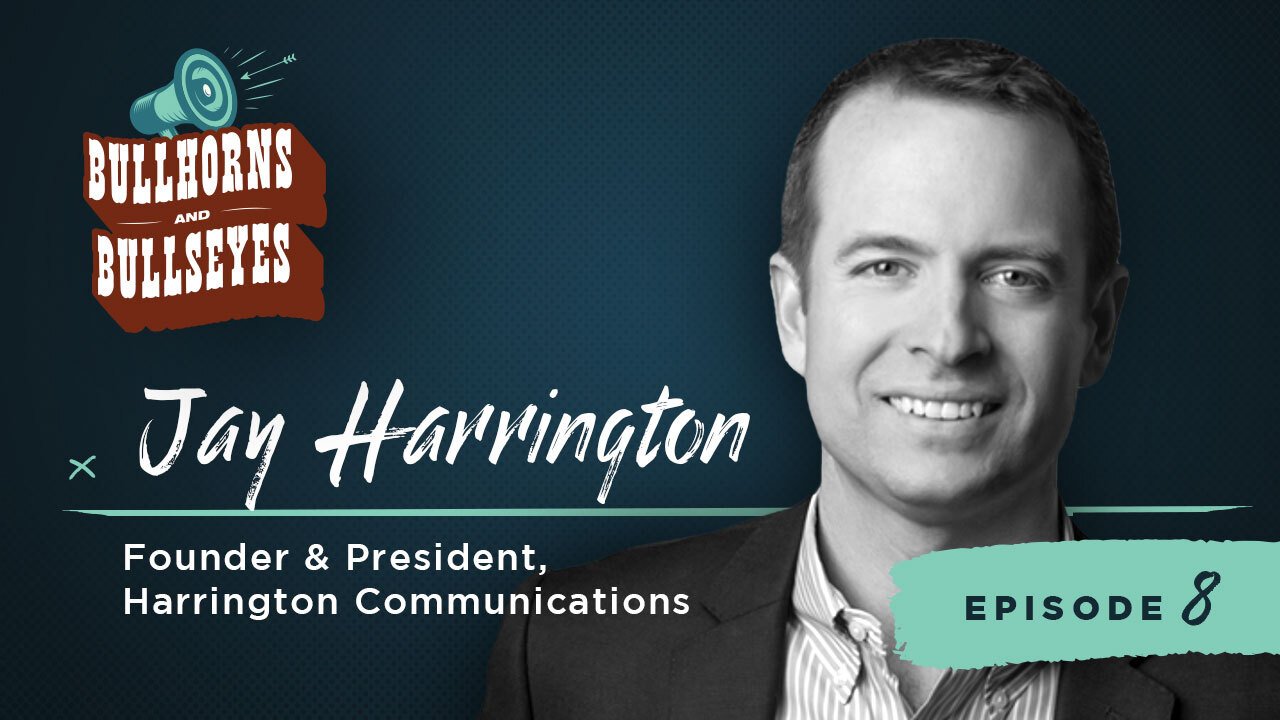
    Jay Harrington is president of the HARRINGTON agency and is one of the country’s leading consultants and strategists in the areas of legal marketing, PR and business development. His particular passion and profound area of expertise is building a network and growing an audience on LinkedIn to generate more and better new business opportunities.

    In this podcast crossover event — Tom and Jay also separately co-host the Thought Leadership Project podcast — Curtis and they discuss tips for publishing thought leadership and content marketing on LinkedIn.
    Together, they explore the engagement metrics on the platform and the effectiveness of using LinkedIn as an advertising platform. They also highlight the importance of understanding your audience and narrowing your niche, as well as the need for sustained effort and consistency in creating thought leadership content on LinkedIn.

    Takeaways:

    • Thought leadership and content marketing are effective strategies for growing networks, building reputation, and earning trust on LinkedIn.

    • Engagement metrics on LinkedIn have seen fluctuations, but the platform remains a valuable space for reaching a B2B audience.

    • LinkedIn can be used as an advertising platform, with carousel ads and video content performing well.

    • Understanding your audience and creating content that addresses their challenges and interests is crucial for success on LinkedIn.

    • Targeting specific audiences on LinkedIn requires careful consideration of demographics and job titles.

    • LinkedIn’s revenue model is based on keeping users on the platform, making it important to create and share content native to LinkedIn.

  • Podcasting: Your 2024 New Year’s Resolution

    Podcasting: Your 2024 New Year’s Resolution

    DOES THE WORLD REALLY NEED ANOTHER PODCAST?

    The answer to that question may be no. But the more relevant answer is this: The world may not need yet another podcast…but you know who does? Your narrowly defined target audience.

    People likely laugh at my dogged enthusiasm for podcasting as a thought leadership platform. Want to know why I’m such an avid believer?

    Busy executives and decision makers—the people you need to reach and sell to—self report that audio is becoming their preferred format of media consumption for a variety of reasons:

    It’s passive: They can consume it on the go, during a commute or while working out.

    It’s immersive: Though they may be doing something else at the time, you have their full and undivided attention for 30 minutes at a time! What other format allows you to achieve that?

    It’s personal: The experience is multi-sensory and four-dimensional. Your audiences will come to feel like they know you personally, which is ultimately who they will award their trust and business to.

    It’s on their timeline: Podcasts are consumed on-demand, meaning podcasters maximize their exposure in this new world of anytime/anywhere media consumption.

    Remember, if you are producing a podcast to grow your business—and not be the next internet celebrity—you don’t need to appeal to everybody. You only need to serve a very distinct and defined core audience. Unless you’re the next Joe Rogan or Howard Stern, you’re not going to amass an audience of millions. But that’s not the point. 

    THE SMALLER YOU GO, THE BIGGER YOU’LL BE

    Consider my friends Bryan O’Keefe and Gena Usenheimer, who co-host “Into the Breach,” which bills itself as “the first law firm podcast exclusively devoted to reps and warranties insurance and the transactional risk markets.” Whoa. Talk about niche. What even is that, you might be asking. 

    Yes. Extremely niche.

    When Bryan approached us about his idea to start a podcast serving a very niche audience, he really meant niche. He told me, there are maybe 20 companies in the entire world that would be in a position to hire me and my firm for this type of work that I specialize in. My audience is a very specific person within those types of companies. I figured, the largest his audience might ever get would be one or two hundred people.

    Did that discourage Bryan and Gena? No. It emboldened them.

    Bryan told me, “Nobody out there is doing this type of podcast. Nobody’s serving this audience. We have the opportunity to be the first. And if we do it well, we may be able to stake out a position as the only podcast serving this market.”

    SMALL BALL YIELDS HOME RUNS

    So how’d that turn out for them?

    Bryan wrote me on LinkedIn, “Gena and I saw an incredible explosion of work in the last two months.  We were averaging about [X] deals per month previously. And we’ve had [10X] the last two months, including [6X] alone this month!  It was a very good ‘problem’ to have. We can’t say enough the role that we think the podcast is playing in the growth.” 

    You can do the same for you and your podcast. But resist the urge to appeal to a mass audience, and instead target only a small niche, with niche content and specialized expertise.

    So here’s step one: Complete this sentence:

    My podcast is going to provide valuable  __________________ for ___________________.

    The first blank is your content focus. The second is your audience. 

    Now you’re off and running…and your first professionally produced podcast is closer than you think.

  • Notification: You Have Notifications Pending.

    Notification: You Have Notifications Pending.

    You’ve Got Maelstroms

    Everything’s a notification these days.

    Are you finding it annoying?

    Check in on virtually any social media platform, and you’ll be bombarded with notifications, badges and prompts. About…well, just about anything.

    It used to be that you’d only receive timely, important and relevant notifications, specific to your own behaviors and actions on any given platform. Now, if some random connection posts something, comments on something, or so much as bats an eyelash emoji online, rest assured, you’ll get a notification.

    Make It Go Away

    Perhaps this mini-rant can serve as a periodic reminder for you to go into your notifications settings and prune them as you see fit.

    Remember: You are the product. These apps and websites are trying to maximize your time and engagement on the platform. There’s nothing inherently evil about that, but you SHOULD take as much of it into your own hands as possible.

    Remember, too, what Greg McKeown wrote in Essentialism: “If you don’t prioritize your life, someone else will.”